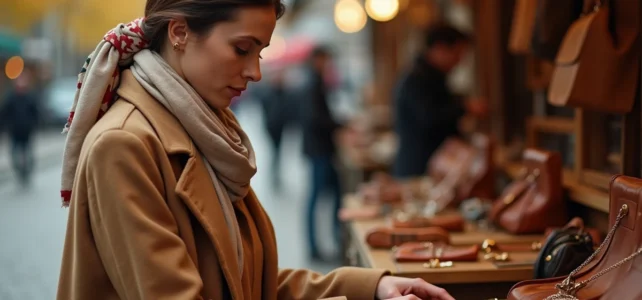
Fashion accessories are undergoing a phase of reconfiguration. Current trends are no longer limited to a catalog of pieces to wear: they reflect choices of materials, shapes, and functions that redefine how an outfit is constructed. The market is shifting towards more precise lines, natural materials, and bold volumes, far from the discreet minimalism that dominated in recent years.
Natural materials and fashion accessories: a style criterion in its own right
The choice of an accessory is no longer reduced to its shape or color. The material becomes a selection filter as decisive as the design. Straw bags, raw leather belts, and jewelry made from untreated materials are gaining ground in seasonal looks.
This shift can be explained by a sought-after coherence between the pieces in the wardrobe. A woven straw bag naturally complements an outfit made of linen or denim, whereas a synthetic accessory would create a visual break. The material of the accessory conditions the coherence of the look, and this criterion now weighs as much as the cut or color.
Among the accessories on the Fimina Mag site, this logic of materials that harmonize with each other rather than simply “decorating” an outfit is evident. Field feedback diverges on this point: some designers believe that straw remains confined to summer, while others see it as a viable material year-round when worked with rigid structures.

Gold jewelry with organic shapes: the trend replacing generic XXL
Oversized jewelry is not disappearing, but its aesthetic is changing. The direction taken by recent collections favors organic and sculptural shapes in gold metal, with irregular volumes that evoke natural textures rather than strict geometries.
This shift marks a break from XXL earrings and necklaces with smooth, predictable lines. Current pieces play with asymmetry, dimpled surfaces, and contours that mimic the movement of a branch or a polished pebble.
What distinguishes a sculptural piece from a classic costume jewelry
The difference lies in the intention of volume. A classic costume jewelry enlarges a known shape (a circle, a square). A sculptural piece offers a shape that cannot be named in one word. It is this ambiguity that creates the sought-after visual effect.
In practice, these pieces work better with understated outfits. An organic-shaped ring worn on a monochrome ensemble becomes the focal point effortlessly. One sculptural piece is enough to structure a silhouette, simplifying the pairing work for those who hesitate to accumulate accessories.
Oversized sunglasses: beyond the basic, very distinctive frames
Oversized sunglasses remain dominant, but the trend is evolving towards more pronounced shapes. This season’s XXL frames do not seek discretion: they impose a facial frame that alters the perception of the entire face.
Very distinctive frames replace neutral oversized ones that mainly served as sun protection. Exaggerated butterfly shapes, squares with sharp angles, and enveloping frames stand out from basic models.
Choosing sunglasses according to face shape and outfit
A common mistake is to select sunglasses based on trend without considering morphology. Here are some concrete guidelines:
- A round face benefits from angular frames that create contrast, rather than rounded shapes that accentuate roundness.
- An elongated face can handle wide and low frames, which rebalance vertical proportions.
- Colorful oversized frames function as a standalone accessory: they replace a necklace or earrings in the visual balance of the outfit.
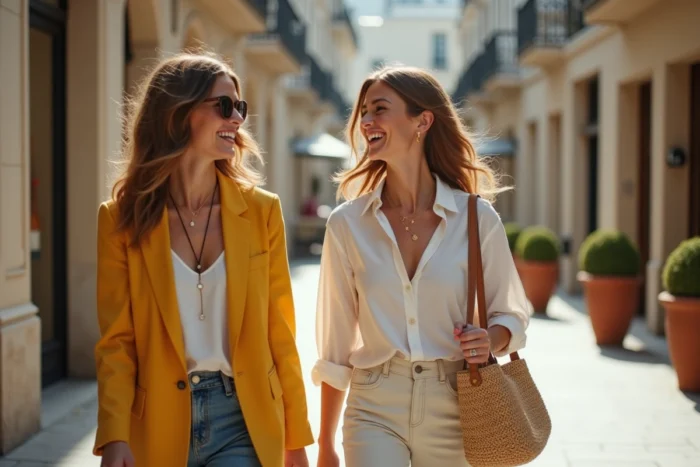
Baguette bags and scarves: the retro return of the 1990s as a seasonal marker
The baguette bag worn under the arm is establishing itself as a strong marker of the season. This compact format, popularized in the 1990s, returns with proportions faithful to the original: narrow, short, worn close to the body.
This return is not just a vague vintage wave. The 1990 baguette bag constitutes an identifiable sub-segment, distinct from the generic “retro” that encompasses several decades. Its elongated silhouette alters posture and gesture, making it an accessory that structures the outfit as much as it complements it.
The scarf follows a parallel trajectory. Tied to the bag, worn as a headband, or slipped into a collar, it adds a touch of color with minimal investment. Bright colors and geometric prints dominate, contrasting with the neutral tones of basic clothing.
Pairing a scarf with an outfit without overloading the look
- On a solid bag, a patterned scarf creates a visual focal point without weighing down the silhouette.
- Worn as a headband on loose hair, the scarf replaces a headpiece and works better with subtle makeup.
- Tied as a belt on high-waisted jeans, it adds a localized touch of color that draws attention to the waist.
The available data does not allow us to conclude whether these retro pieces will remain beyond the season. The cap and wide-brimmed hat still coexist in wardrobes, a sign that the head accessory market remains fragmented, without a single dominant trend.
The common thread among all these accessory trends is their ability to alter the perception of a complete outfit with a single well-chosen piece. The material, shape, and placement on the body matter more than accumulation. A well-tied scarf is preferable to a layering of jewelry without intention.