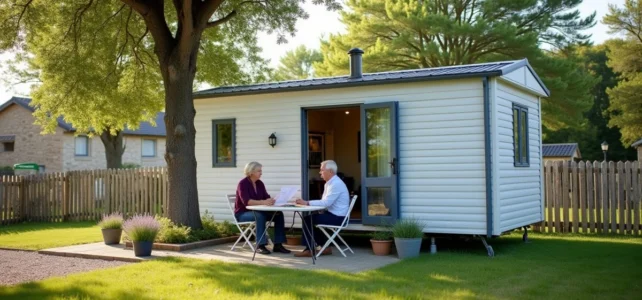
A mobile home placed on private land is not subject to the same legal regime as a traditional construction, but the boundary diminishes as the occupancy exceeds the seasonal framework. Since the enactment of the ALUR law, we have observed a persistent confusion between the status of mobile leisure residence and that of permanent housing, a confusion that urban planning services are increasingly penalizing.
Requalification as permanent housing: the trap of private land
The point that most guides overlook is the requalification mechanism. As soon as a mobile home installed on private land serves as a primary residence for more than eight months a year, the instructing services can require a change of status to a removable residence constituting permanent housing, a regime created by the ALUR law.
This requalification leads to an obligation for urban planning authorization. Below 40 m², a prior declaration is sufficient. Beyond that, a development permit becomes necessary. The land must be located in a sector of the PLU that allows this type of installation, which remains rare outside of designated areas (sectors with limited size and capacity, known as STECAL).
In practical terms, an owner who connects their mobile home to utilities (water, electricity, sanitation), removes the wheels, or pours a slab, provides the administration with material proof of a permanent installation. The legislation on mobile homes on private land is based on a simple principle: as long as mobility is maintained and occupancy is limited, the regime remains flexible. As soon as one of these two criteria disappears, the framework shifts.

Temporary installation on private land: the three-month threshold and its real conditions
Below three months of occupancy per calendar year, no urban planning authorization is required. The mobile home must retain its means of mobility (wheels, tow bar) and not receive any fixed external modifications (masonry terrace, sealed awning).
This provisional installation regime is not a blank check. The PLU or the municipal map may prohibit any parking of mobile leisure residences, including temporary ones. We systematically recommend consulting the regulations of the concerned area at the town hall before any delivery.
Another subtlety: the three-month duration is assessed cumulatively over the year. Three stays of one month, even spaced out, reach the threshold. Exceeding this exposes one to a report of violation of the urban planning code, with an obligation to restore the land.
Non-buildable land and mobile homes: what the ALUR law really allows
The ALUR law of 2014 never opened a general right to install a mobile home on non-buildable land. It created a derogatory regime for removable residences constituting permanent housing for their occupants, provided that the PLU identifies dedicated sectors.
In practice, the municipalities that have delineated these STECAL areas remain few. An owner of land in agricultural (A) or natural (N) zones cannot, except for local exceptions, place a mobile home there permanently. The confusion arises from the fact that the ALUR law is often cited as a green light when it actually sets a strict conditional framework.
Risk of cabinization on private land
Prefectures and local authorities are strengthening controls against cabinization, meaning the illegal occupation of land by light constructions or mobile homes without authorization. Legal actions are multiplying, and administrative courts regularly order restoration under penalty.
A mobile home placed on non-buildable land without a valid urban planning title falls under this qualification. The absence of a foundation does not protect against a violation of the urban planning code.
Multiple mobile homes on the same land: requalification as a camping activity
The installation of several mobile leisure residences on the same private land can trigger a requalification as a camping activity or as a residential leisure park (PRL). This administrative trend, documented for several years, targets owners who rent out spaces or host third parties.
The consequences are significant:
- Obligation to declare or obtain authorization to develop depending on the number of spaces, with safety and accessibility standards specific to outdoor establishments
- Compliance with urban planning rules applicable to campgrounds (occupancy density, limited land footprint, connection to collective networks)
- Subject to the tourist tax and, if applicable, social contributions if the activity is considered commercial
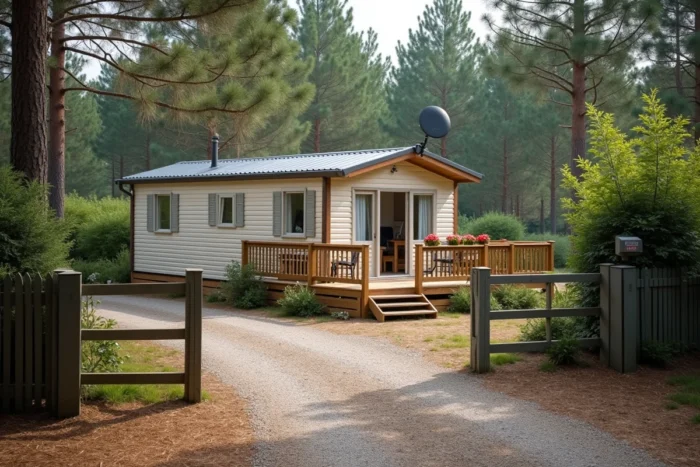
Taxation of mobile homes on private land: property tax, housing tax, and CFE
A mobile home retaining its mobility (wheels, chassis, tow bar) is not subject to property tax since it does not constitute a construction in the fiscal sense. It also escapes the housing tax on secondary residences, which has been abolished for primary residences but maintained for secondary residences.
The situation changes if the mobile home loses its mobility attributes. A concrete slab, the permanent removal of wheels, or a permanent anchoring to the ground can lead the tax administration to requalify it as a construction, with the application of property tax on built properties.
For owners who regularly rent their mobile home on private land, the business property tax (CFE) may apply if the activity is considered professional.
Insurance and liability
Standard multi-risk home insurance does not always cover a mobile home on private land. A specific mobile leisure residence contract is recommended, covering natural risks, theft, and civil liability related to the occupation of the land.
The distinction between seasonal occupancy and permanent residence also conditions the type of coverage. An insurer will require details on the annual occupancy duration before issuing a proposal.
The legal framework for mobile homes on private land remains a balance between regulatory flexibility and administrative control. Maintaining mobility, adhering to the three-month threshold, and verifying the local PLU are the three prerequisites for any installation. Neglecting any of them exposes one to restoration procedures that administrative courts no longer hesitate to uphold.