The French market for disposable diapers has long pitted a leading brand, Pampers, against a galaxy of sub-brands and alternatives that are nibbling away at shelf space. Private label brands (Leclerc, Lidl, Intermarché), French brands focused on composition (Love & Green, Joone, La Marque en moins), or low-cost imported ranges: the offering has fragmented to the point of making comparison difficult for parents. The criteria for choice go beyond the simple unit price displayed on the shelf.
Composition of Pampers diapers compared to alternative brands
The first area of distinction between Pampers and its competitors lies in the formulation of materials in contact with the skin. Pampers uses an inner layer and an absorbent core made from sodium polyacrylate, a superabsorbent polymer standard in the industry. The brand communicates about the absence of certain controversial substances (parabens, natural latex), but the complete list of components remains poorly detailed on the packaging.
Several French sub-brands have chosen an opposite strategy: to fully publish the composition of their diapers. Joone, for example, is highlighted by content creators as a diaper made in France with rigorous traceability for each batch. Love & Green claims to be free of lotion, fragrance, and most common allergens. La Marque en moins adopts a similar positioning, with a subscription model that allows checking the technical sheet before each order.
To delve deeper into the difference between Pampers diapers and sub-brands, one must look beyond marketing: the presence or absence of certain petrochemical derivatives in the top layer, the type of cellulose used (chlorine-bleached or TCF), and the potential use of moisture indicators based on ink. On these specific points, the “clean” sub-brands often display more transparency than Pampers.
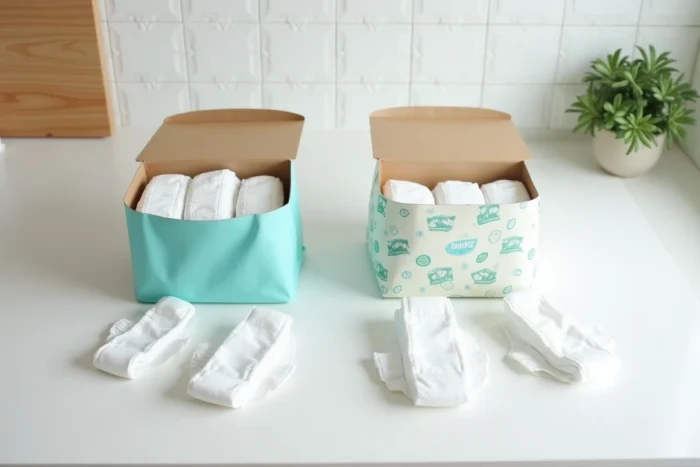
Unit price and total cost over 30 months: Pampers vs. La Marque en moins
The shelf price alone is not enough to measure the real gap between the two categories. A comparison conducted by the blog Les Avis d’Emilie simulates a diaper subscription over 30 months, from birth to potty training. The results shed light on a gap rarely quantified in general guides.
- The average price per diaper for La Marque en moins is around €0.23 for smaller sizes, compared to about €0.38 for Pampers in the same comparison.
- Over the total duration of use (about 30 months), the La Marque en moins subscription would save more than €800 compared to Pampers, for equivalent daily change usage.
- Occasional promotions in supermarkets reduce this gap for Pampers, but they require constant monitoring and large storage at home.
This calculation over the total duration changes the perspective. A gap of a few cents per diaper seems insignificant on a daily basis. When multiplied by several thousand diapers used before achieving potty training, it weighs heavily on a family budget.
Absorption and leaks: what tests do not always resolve
Absorption remains the number one functional criterion for parents. Pampers Baby-Dry and Pampers Premium Protection regularly rank among the highest-rated diapers in comparative tests for their ability to keep the skin dry overnight. Pampers’ multilayer absorbent core benefits from decades of R&D and a production volume that allows for optimized distribution of the superabsorbent gel.
Field feedback diverges on this point when comparing with certain sub-brands. Brands like Bébé au Naturel or Love & Green show adequate absorption capabilities for daytime use, but parental feedback reports more nighttime leaks in certain sizes.
The fit plays a crucial role: the elastics at the thighs and waist vary greatly from one brand to another, and an improper fit for the baby’s morphology causes leaks, regardless of the quality of the absorbent core. The available data does not allow for a conclusion that one category consistently outperforms the other.
Sizes and fit: an underestimated factor
Pampers offers an extensive range of sizes, including intermediate sizes (the “+ sizes”) that cover narrow weight ranges. This granularity allows for better fitting during rapid growth phases. Most sub-brands limit themselves to standard sizes (1 to 5 or 6) without intermediate sizes, which can pose a comfort issue between two weight thresholds.
The choice of size depends on the baby’s weight and not their age. This is a basic point, but often misunderstood. A diaper that is too large leaks at the thighs, while a diaper that is too tight irritates the skin at the waistband.

Pants diapers and specialized ranges: an advantage for Pampers
One area where Pampers maintains a lead is in the depth of its range. Pants diapers for the potty training phase, Splashers for the pool, the Harmonie range focused on plant-based materials: Pampers covers specific uses that most sub-brands do not address.
Alternative brands generally focus on the classic everyday diaper. Few offer a credible equivalent to swim diapers or nighttime pants with enhanced absorption. For parents who want to stick with a single brand from morning to the pool, Pampers simplifies logistics.
However, this depth of range comes with a complexity of choice: Baby-Dry, Premium Protection, Harmonie, Pants, Night Pants. Navigating between these references without a clear selection guide remains a barrier, especially for first-time parents.
The choice between Pampers and a sub-brand is not just a quality-price duel. It involves trade-offs regarding composition transparency, range depth, fit for intermediate sizes, and purchasing mode (shelf or subscription). A parent who switches brands according to growth periods and uses often makes a more relevant choice than a parent who sticks to a single reference out of habit.