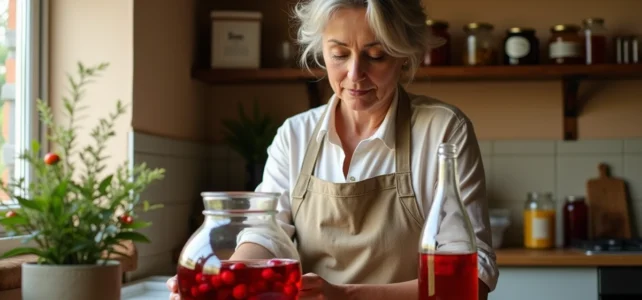
90° alcohol for fruits refers to undenatured ethanol, food-grade quality, used for macerating fruits in jars or preparing homemade liqueurs. At Leclerc, this product is receiving increasingly mixed consumer feedback, with shortages on the shelves and ongoing confusion with bottles intended for cleaning.
Alcohol content and maceration: what chemistry changes in the jar
Before judging a product on the shelf, a technical concept needs to be established. The alcohol content directly determines the extraction capacity of flavors and the preservation of fruits.
An alcohol with 90° quickly dissolves the aromatic compounds of fruits (esters, terpenes) and creates a hostile environment for bacteria. The result: maceration starts quickly, and the jar can be stored for a long time without pasteurization.
With a 40° or 45° spirit, the extraction is slower and less complete. The fruits retain more of their texture, but the aromatic profile of the finished product is less pronounced compared to a 90° maceration. For a cherry liqueur or walnut wine, the difference in concentration is clearly felt on the palate.
The choice of degree therefore depends on the objective. For fruits in spirit intended to be consumed whole, a 40° alcohol is sufficient. For a filtered liqueur where a marked aromatic intensity is sought, 90° remains the technical reference. Several consumers who have tested Leclerc’s fruit alcohol report that substituting with a 40° alcohol significantly alters the final result.
Food alcohol or household alcohol at Leclerc: read the label above all
The main trap is located in the household goods section. The bottles of 90° alcohol found there are, in the vast majority of cases, denatured modified alcohol, intended for household cleaning. Their composition includes additives (camphor, bitrex, methyl ethyl ketone) that render them unfit for consumption.
These denaturing agents do not evaporate during maceration. Pouring this type of alcohol over fruits poses a real health risk, even after several weeks of resting.
To distinguish between the two products, there is only one reliable reflex: check that the label states “food alcohol” or has an explicit approval for liqueur preparation. Without this indication, the bottle is not intended for culinary use, regardless of the displayed degree.
Labels to look for on the bottle
- “Ethyl alcohol of agricultural origin” followed by the mention “food” or “for fruits”: this is the product suitable for maceration
- “Modified alcohol” or “household alcohol”: denatured product, strictly reserved for cleaning, prohibited in cooking
- A high degree (90°) without any mention of food use: consider the product as inedible by default
Availability of food-grade 90° alcohol at Leclerc in 2026
Since the end of 2023, several E.Leclerc hypermarkets and drive-throughs have removed food-grade 90° alcohol from self-service. The product is replaced, depending on the point of sale, by alcohols with 40° to 45° or by ready-to-use flavored preparations.
This trend is not uniform. Some stores continue to offer the reference, while others have removed it without specific communication. Availability varies from one Leclerc to another, even within the same region.
Several factors explain this decline. The rise of non-alcoholic and low-alcohol beverages is prompting retailers to reconfigure their liquid aisles. Technical products like fruit alcohol, which are not prominently featured and generate modest revenue, are being relegated or simply delisted.
Check the Drive before heading out
The online catalog at courses.leclerc allows you to check the availability of the product in a specific store. Searching with keywords “fruit alcohol” or “food alcohol 90” displays the references in stock. Consulting the Drive avoids unnecessary trips, especially during the summer when demand surges.
Note: a product listed as “available” online may be temporarily out of stock in the store. The product page on the Leclerc website does not always guarantee physical presence on the shelf.
Consumer reviews: what recent feedback reveals
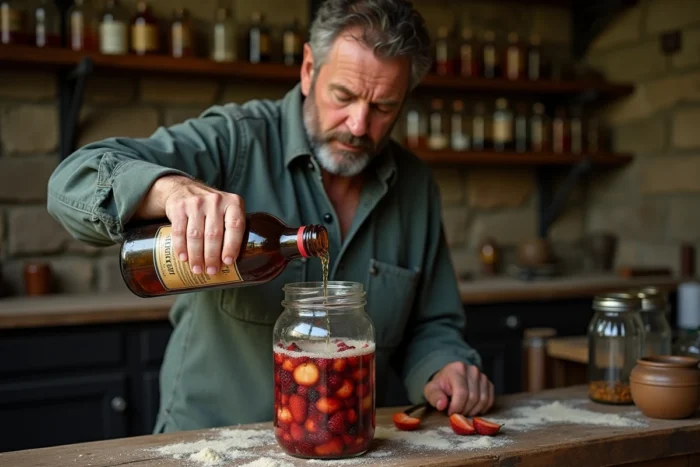
The feedback published on product pages at courses.leclerc and on cooking forums paints a mixed picture. Satisfied consumers mention a neutral-tasting product, effective for macerating cherries, plums, or walnuts.
Negative reviews mainly focus on two points:
- The confusion between food alcohol and household alcohol, leading to disappointments and sometimes health risks for inattentive buyers
- The disappearance of the product from the shelves without a clearly identified alternative, forcing consumers to turn to other purchasing channels
- The replacement with 40° alcohols deemed insufficient to achieve a comparable quality maceration
The intrinsic quality of the product is not called into question by users who have been able to purchase it. The problem lies in access to the product and the lack of clarity in the in-store offering.
Alternatives when the Leclerc shelf is empty
When food-grade 90° alcohol is no longer available at Leclerc, several options exist. Pharmacies sometimes sell undenatured ethyl alcohol, but at prices significantly higher than in supermarkets.
Local distilleries and agricultural cooperatives offer neutral food-grade alcohol, often of wine origin. This short supply chain provides a traceable product, with a degree suitable for maceration.
White spirit at 40° or 45° (such as kirsch, mirabelle, marc) is a practical compromise. The result on the palate differs from a 90° maceration, but the product is easily accessible and adds a distinct aromatic note that can enhance certain preparations.
Specialized websites for distillation and canning equipment also sell food-grade 90° alcohol online, with home delivery. Prices remain comparable to those in supermarkets, excluding shipping costs.
Fruit alcohol at Leclerc remains a good product when available. The real issue in 2026 is not its quality, but its increasingly uncertain presence on the shelves, which forces consumers to anticipate their purchases or diversify their sources of supply each season.