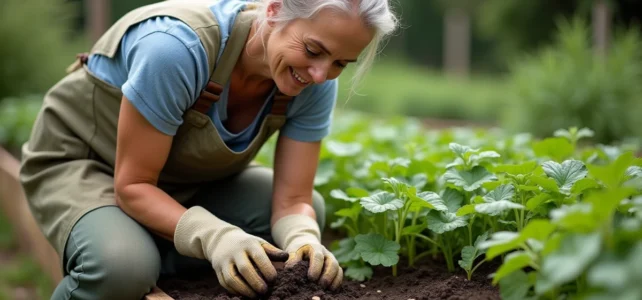
In a vegetable garden in the middle of summer, purslane (Portulaca oleracea) colonizes any bare space within days. Its fleshy stems break when pulled, and each fragment left on the ground takes root again. Before looking for a natural herbicide for purslane, it’s wise to ask a preliminary question: do we really need to get rid of it everywhere, or only where it concretely hinders a crop?
Purslane in the vegetable garden: weed to eliminate or edible ground cover to keep
Purslane is often pulled out reflexively because it grows where it hasn’t been sown. However, this plant is richer in omega-3 than any other leaf in the vegetable garden. Several recent gardening guides present it as one of the most interesting weeds to leave in place in certain areas.
In practice, it’s beneficial to distinguish between two situations. In rows of direct sowing (carrots, radishes, lettuce), purslane competes for light and water as soon as it emerges: here, quick intervention is necessary. In contrast, at the base of staked tomatoes, zucchini, or already established shrubs, purslane covers the soil, limits evaporation, and can be harvested for cooking.
Adopting a natural herbicide for purslane makes sense in sensitive cultivation areas. Elsewhere, this plant can be tolerated, or even regularly harvested to slow its seed production without chemical effort.
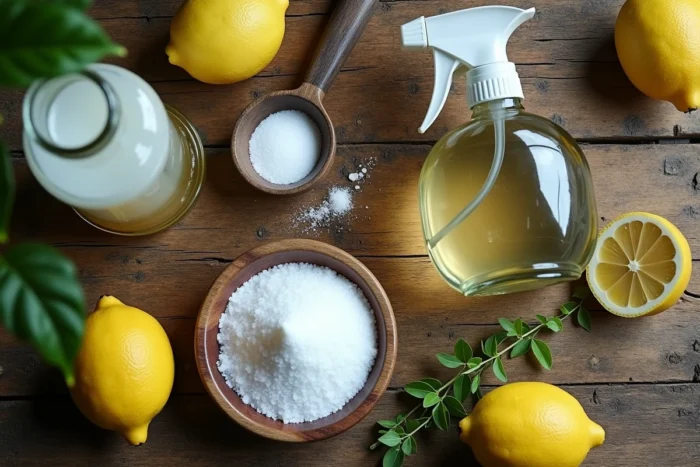
Legal status of vinegar and salt used as natural herbicides
The mixture of white vinegar and coarse salt comes up in all gardening forums. However, one point often goes unnoticed: vinegar-salt preparations are considered pesticides under French law. Without a Marketing Authorization (MA), their use as herbicides is non-compliant, even if the ingredients are common household products.
You won’t risk a police raid for pouring vinegar on a path. The issue lies elsewhere: salt accumulates in the soil, degrades its structure, and makes the land unsuitable for planting for years. On a paved terrace or a gravel path, the impact remains limited. On a cultivation bed, it’s a lasting mistake.
What salt does to the soil
Sodium chloride causes osmotic shock to the roots, which dries out the plant. The problem is that salt does not distinguish between purslane and neighboring vegetables. It remains in the top layer and migrates with watering. In clay soil, the effect persists for a long time.
Feedback varies on this point depending on soil type and local rainfall, but the precautionary principle remains the same: reserve salt for mineral surfaces, never for cultivated areas.
Effective field methods against purslane in cultivation beds
Purslane spreads by seeds and stem fragments. Each piece left in warm, moist soil takes root again within days. Natural solutions must therefore act on both vectors simultaneously.
Thermal weeding with boiling water
The cooking water from pasta or potatoes, poured directly onto the purslane plants, destroys plant cells through thermal shock. This is the simplest method for a small area. Pour slowly, close to the ground, targeting the crowns.
- Immediate effectiveness on aerial parts, but regrowth is possible if stem fragments remain intact below the surface
- No chemical residues in the soil, compatible with an organic vegetable garden
- To be repeated after each emergence of new seedlings, about every ten to fifteen days in mid-summer
Thick mulching to cut off light
A sufficiently dense mulch prevents purslane germination by depriving it of light. This can include straw, wood chips, or brown cardboard laid on moist soil. Purslane needs heat and direct light to germinate: without these two factors, the seeds remain dormant.
The mulching only works if it is installed before emergence. Once purslane is already in place, it should first be pulled out manually, then immediately covered to block the next wave.
Targeted hoeing at the right time
Hoes remain the most reliable method on vegetable beds. The key is timing: intervene when purslane seedlings have two to four leaves, before they produce seeds. At this stage, a surface hoeing is sufficient.
- Hoe on dry, sunny days so that the pulled fragments dry out on the spot instead of regrowing
- Avoid turning the soil deeply, which would bring buried seeds to the surface
- Collect cut stems if the soil is moist, as a fragment of purslane on wet soil can take root within hours
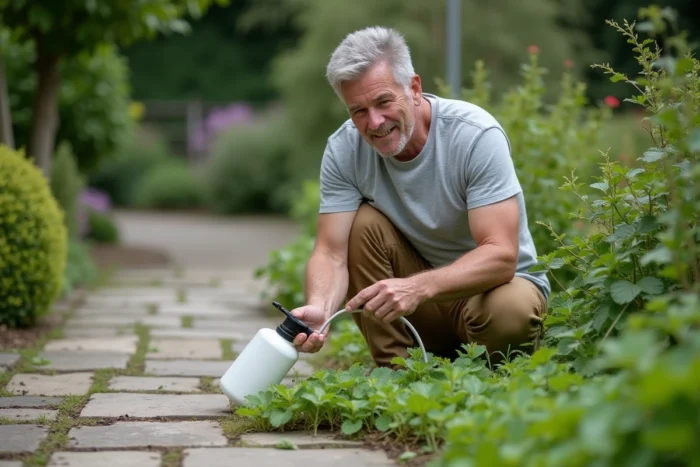
Combined strategy: harvesting, mulching, and hoeing against purslane
None of these methods work alone against an established infestation. On the ground, the most effective combination follows a simple cycle: early hoeing of sowing rows, immediate mulching after hoeing, and regular harvesting of tolerated plants elsewhere in the vegetable garden.
Harvesting purslane before it flowers drastically reduces the seed stock in the soil from one season to the next. Cut the stems close to the ground with a knife, which provides tender leaves for salad and deprives the plant of its ability to reseed.
Managing purslane rather than eradicating it means integrating this weed into the vegetable garden rotation. It is allowed to serve as edible ground cover where it does not hinder, and it is mechanically removed where crops need it. This approach requires more observation than product use, but it yields lasting results without damaging the soil.