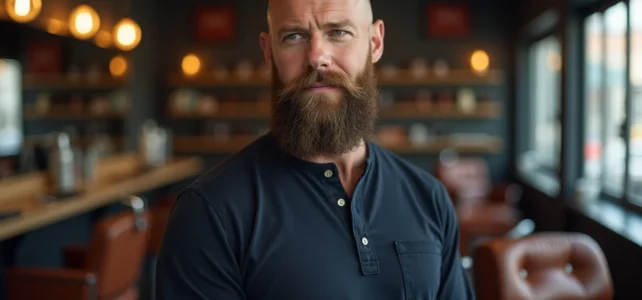
A shaved head draws the eye down the face. Jawline, chin, neck: everything becomes visible, without the slightest fringe or cut to soften any imbalance. In this context, the beard does not serve as a compensation. It redistributes the proportions of the face and alters the perception of its shape. The choice of a beard style for a bald man is based on specific morphological criteria, not on a generic trend.
The actual density of hair remains the most common and least addressed constraint. A man whose beard grows unevenly cannot apply the same techniques as another with homogeneous hair growth. It is this starting point that changes the entire approach.
Beard Density and Shaved Head: The Constraint That Changes Everything
The majority of articles assume that the beard grows uniformly. Field reports diverge on this point. Many bald men notice sparse areas, genetic patches, or scars that prevent certain styles.
When hair growth shows visible gaps, a classic goatee or long beard can accentuate the irregularity instead of masking it. Choosing what beard style for bald first requires assessing where the hair grows, how fast, and with what thickness.
For beards with gaps, here are some concrete suggestions:
- Shorten the overall length to unify the visual appearance, as a short beard reduces the differences in density between areas
- Work on the contours precisely (cheeks, neck, sideburns) so that the gaze focuses on the line rather than the filling
- Consider a goatee or a style focused on the chin and mustache if the cheeks remain too sparse to wear a full beard
Beard transplants exist and have been gaining visibility in recent years. They concern hairless patches of genetic or scar origin. Results vary depending on the technique used and the area treated, but this option is now offered by several clinics specializing in hair implants.

Bald Face Morphology: Adapting the Beard to the Shape of the Skull
A shaved head modifies the overall silhouette of the head. Without hair, the forehead appears longer, and the temples more exposed. The beard acts as a visual counterbalance, and its effectiveness directly depends on the shape of the face.
Round or Wide Face
A beard that elongates the chin rebalances a round face. A goatee, extended chin beard, or a beard trimmed shorter on the sides and longer at the chin create a verticality that is naturally lacking. Very full cheeks, on the other hand, further widen the perception of the face.
Long or Narrow Face
Conversely, a long face benefits from being widened. A full and even beard on the cheeks adds lateral volume. Styles that are too thin or too vertical (goatee alone, goatee without mustache) accentuate the “long head” effect that the shaved head already amplifies.
Angular or Square Face
Defined jaws support a well-maintained short beard or a three-day beard. A gradient of length between the sideburns and the chin softens the angles without erasing them. The blending work between the head and the beard, often done by barbers, helps avoid a stark visual break between the smooth skin of the head and the hair on the lower face.
Beard and Shaved Head: The Role of Blending and Contours
Barbers are increasingly using very blended fades on the sides to guide the eye towards the overall structure of the face. This transition work also applies to men with completely shaved heads: the junction between the temples (or sideburns) and the beard requires special care.
Sharp contours on the sideburns and neck structure the face as much as the beard itself. A poorly defined neck gives an impression of neglect, even with a well-groomed beard otherwise. The neck line is generally placed above the Adam’s apple, following the natural curve of the jaw.
The blended connection between the head and the beard is a technical point that online guides rarely address. On a smooth head, even the slightest asymmetry in the contours is more noticeable than on a man with hair. Regular visits to a qualified barber remain the most reliable way to achieve this precision.
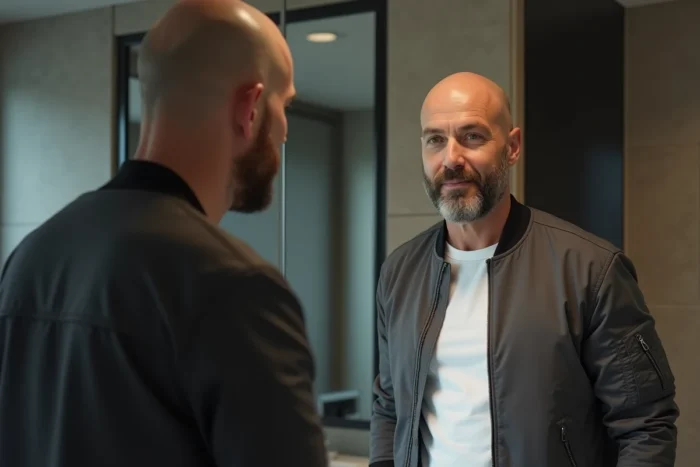
Daily Maintenance of a Beard on a Bald Head
Wearing a beard when bald involves overall maintenance that includes the head. The skin of the shaved head and that under the beard share the same needs: hydration, sun protection, prevention of irritation.
- Moisturize the head and beard with a suitable balm or oil to avoid tightness and beard dandruff
- Trim the contours every two to three days to maintain the sharpness of the line, especially on the neck and cheeks
- Protect the head from the sun with a hat or suitable sunscreen, as sunburn on a shaved head also affects the comfort of the beard due to proximity
- Brush the beard daily to direct the hairs and evenly distribute sebum
The regularity of maintenance matters more than the chosen length. A neglected three-day beard after a week loses its structuring effect. An unbrushed long beard gives a messy appearance that the smooth head makes even more visible.
The duo of a shaved head and beard works when both elements receive the same attention. Choosing a style suited to one’s hair density and facial morphology helps avoid permanent adjustments and frustrations in front of the mirror. A style that is easy to maintain daily, suited to one’s density and face shape, will always yield a cleaner result than a demanding style worn halfway.