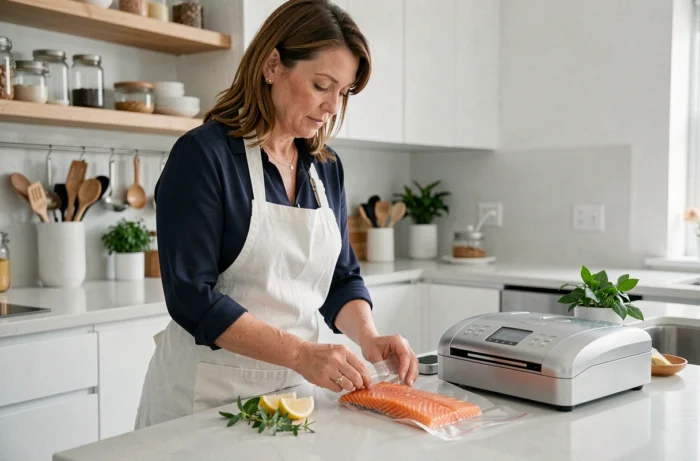
A domestic vacuum machine sucks the air out of a bag before sealing it with heat welding. This process slows down oxidation and bacterial growth, which prolongs the shelf life of food in the refrigerator or freezer. The Magic Vac Maxima 2 is an external suction model designed for regular home use, featuring a sealing bar and an integrated pump capable of handling various types of bags.
Waffle bags and sous vide cooking: an often underestimated ecosystem
The choice of a vacuum machine is not limited to the pump’s power. Compatibility with bags available on the market directly affects what you can do with the device on a daily basis.
The Maxima 2 works with external suction waffle bags, a format shared by several major brands (Lacor, Oster, FoodSaver, Philips-Saeco). This has a practical consequence: you are not tied to a single supplier of consumables, which reduces the cost of use over time.
Some recent European waffle bags can withstand sous vide cooking at 70 °C for two hours and up to 100 °C for fifteen minutes, while still being usable in the freezer. With the Magic Vac Maxima 2 vacuum machine, vacuum sealing becomes the first step in low-temperature cooking at home, not just a preservation gesture.
Always check the temperature ranges indicated by the bag manufacturer before any cooking. A bag designed only for cold storage will not withstand prolonged exposure to hot water.
Pump and sealing of the Magic Vac Maxima 2: what really matters
Product sheets often list the suction speed and power without explaining their real impact. On the Maxima 2, the pump sucks air at a rate sufficient to quickly handle a standard-sized bag, but its power remains modest compared to semi-professional bell models.
For home use (meat portions, vegetables, prepared dishes, cheeses), this power is adequate. It reaches its limits with large volumes of liquid or very moist foods, where a bell machine would provide a deeper vacuum.
The quality of the sealing bar
A reliable seal determines the longevity of the bag over time. The Maxima 2 produces a clean thermal seal across the entire width of the bag. This point is often overlooked in comparisons, while an incomplete or irregular seal negates all the benefits of vacuum sealing: air eventually gets in within a few days.
A concrete indicator: if the bag remains perfectly pressed against the food after several days in the refrigerator, the seal has done its job. A bag that “inflates” indicates a sealing defect or a micro-perforation.
Vacuum food storage: real gains and limits
Vacuum sealing does not sterilize food. It slows down oxidation and inhibits the proliferation of certain aerobic bacteria, but it does not eliminate the risk associated with anaerobic bacteria (which develop without oxygen). The refrigerator remains necessary.
The preservation gains vary depending on the type of food:
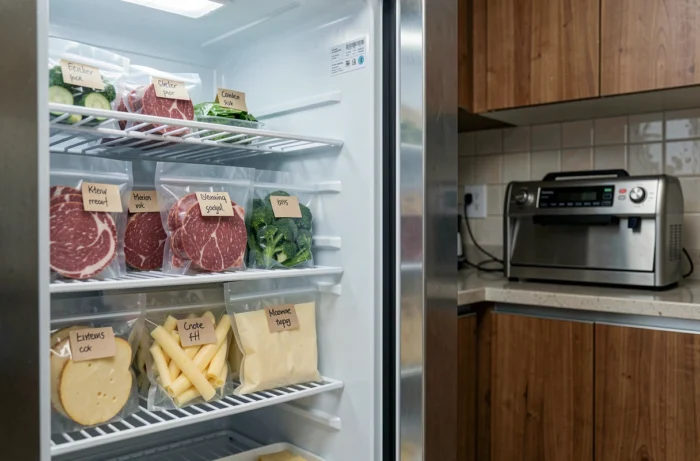
- Raw meats last significantly longer in the refrigerator when vacuum sealed than when wrapped in simple plastic wrap, provided a stable temperature below 4 °C is maintained.
- Raw or blanched vegetables retain their texture and nutrients longer, as the absence of air limits enzymatic browning.
- Prepared dishes can be made in advance and then reheated directly in their bag, simplifying weekly meal prep.
- Hard or semi-hard cheeses store better vacuum sealed, while soft-ripened cheeses (brie, camembert) require different packaging to continue breathing.
Vacuum sealing multiplies shelf life but does not replace the cold chain. A vacuum-sealed food item left at room temperature remains a risky food.
CE marking and safety standards for food machines
The Maxima 2 bears the CE marking, mandatory for marketing in Europe. This symbol means that the manufacturer declares the compliance of its device with applicable safety requirements, but it does not constitute certification by a third-party organization.
Food vacuum machines fall under a body of harmonized European standards that govern mechanical and electrical safety:
- The EN ISO 12100 standard covers risk analysis and general safety of machines.
- The EN 60204-1 standard pertains to electrical equipment.
- The EN 1672-1 and EN 1672-2 standards specifically address machines intended for food contact, with requirements on material hygiene and ease of cleaning.
For a domestic device, these standards ensure that materials in contact with food do not migrate harmful substances and that the machine does not present an electrical risk under normal usage conditions.
Versatility and compact format: a device for which user profile
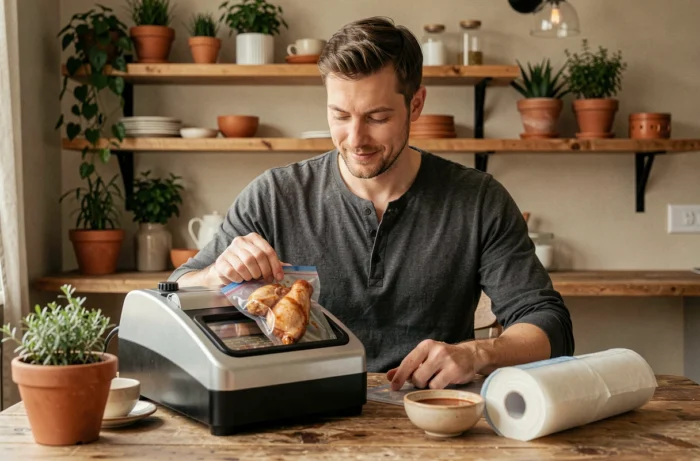
The Maxima 2 accepts bags of different widths, allowing it to handle both small individual portions and larger pieces. Its compact format makes it storable in a standard kitchen cupboard, a tangible advantage over bell machines that often weigh several dozen kilos.
This device is suitable for households that do bulk shopping and wish to portion and then store meats, fish, or prepared dishes for the week or month. For intensive professional use or processing large quantities of liquids, a bell model would be more appropriate.
The Maxima 2 positions itself between entry-level models (fragile seals, weak pump) and semi-professional devices (bulky, more expensive). This intermediate positioning explains its longevity in the market and the wide availability of compatible consumables.


