Doro AB is no longer an independent entity. The Swedish brand, founded in Lund in 1974, now operates under the umbrella of the Norwegian group Xplora Technologies. This affiliation changes the usual perception of a player long presented as a small Scandinavian manufacturer specializing in senior telephony. Understanding who actually manufactures Doro devices, and according to what industrial logic, requires tracing the value chain beyond the simple logo printed on the casing.
Integration of Doro into the Xplora Group: what industrial consolidation changes
Since the mid-2020s, Doro has been integrated into the scope of Xplora Technologies, a publicly traded group that encompasses several brands in the senior and children segments.
This consolidation has a direct consequence on product design. Xplora shares its technological platform among its various brands. Smartphone development relies on a common software and hardware architecture, which is then adapted by brand and segment. For Doro, this means a reduction in unit R&D costs and access to technological components (connectivity, security, interface) shared with other ranges of the group.
We observe that this multi-brand group model on a single platform is common in consumer electronics but remains under-documented in the senior segment. It allows Doro to maintain a product renewal pace without bearing the development costs of a tailored OS or a teleassistance software layer alone.
To delve deeper into the topic of Doro manufacturing and brand origin, it is necessary to look beyond the headquarters in Lund and consider the entire Xplora ecosystem.
Doro Production and Asian Outsourcing: the reality of the manufacturing chain

Doro does not own a manufacturing plant. The phones are assembled by subcontracting partners, primarily located in China. This fabless model, where the brand designs and specifies but does not produce, has been the norm in mobile telephony for over fifteen years.
Product design (ergonomics, interface, hardware specifications) is still managed from Sweden. Industrial design, material choices, button sizes, sound levels, and software structure are defined internally. Physical production, on the other hand, relies on Asian ODMs (Original Design Manufacturers) capable of managing modest volumes compared to industry giants.
Buying a Doro means purchasing a product designed in Sweden and assembled in Asia, with quality control and specifications dictated by the Doro team. The added value lies in software and ergonomic adaptation, not in the assembly line.
Senior Phone Market in Europe: Impact of 2G/3G Shutdowns on Doro Sales
The market in which Doro operates has experienced a surge in demand related to the gradual shutdown of 2G and 3G networks in Europe. Millions of senior users equipped with old devices have had to migrate to 4G-compatible devices, creating a wave of renewal concentrated over a few years.
This peak is now in a phase of normalization. Sales volumes of senior phones, including Doro, are stabilizing as the installed base shifts to 4G. For Doro, this implies a gradual repositioning: growth will no longer come from mere forced replacements but from the ability to offer recurring services (teleassistance, connected subscriptions) and to retain a user base.
- The end of 2G forces the replacement of devices sometimes used for over ten years, an unusual cycle in traditional telephony.
- European operators do not all follow the same shutdown schedule, which fragments demand by country.
- The refurbished and second-hand market in the senior segment remains marginal, unlike the mainstream smartphone market.
Doro Design and Product Strategy: what truly distinguishes the brand
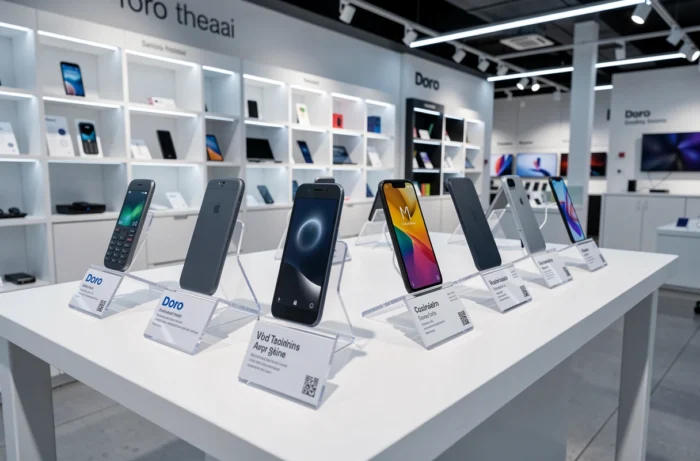
Doro differentiates itself through a design approach focused on usage, not on technical specifications. The brand’s flagship models do not aim to compete in processor power or photo quality with mainstream smartphones. The interface, sound volume, and screen readability are the real design criteria.
Design choices follow a specific logic: wide physical buttons on flip models, emergency button on the back, simplified menus with oversized icons. The available colors (red, black, white depending on the ranges) respond to usage studies on visual contrast and grip.
In the smartphone segment, Doro offers devices running Android with a proprietary overlay that masks the system’s complexity. This work on the adapted software layer represents the core of Doro’s expertise, much more than the hardware itself. It also justifies the price positioning, generally higher than that of a classic entry-level smartphone with equivalent features.
Doro and Teleassistance: the shift towards connected services
Doro’s strategy is no longer limited to selling devices. Teleassistance and connected subscriptions are the main growth drivers. The Xplora group explicitly communicates about the increasing importance of recurring revenues from monthly subscriptions, a business model much more predictable than the unit sale of phones.
In practice, Doro offers solutions combining hardware (bracelet, pendant, smartphone) and service (fall detection, geolocation, emergency call). This segment of connected teleassistance is experiencing structural growth in Europe, driven by demographic aging and political will for home care.
- Doro’s teleassistance solutions work in addition to or as a replacement for traditional pendant devices.
- The monthly subscription model stabilizes revenues and creates a continuous relationship with the user.
- Integration into Xplora allows for the sharing of cloud infrastructure and monitoring platforms among several brands of the group.
The Doro brand has profoundly changed in nature since its beginnings in telephone answering machines in Lund. Its activity now relies on the integration of services for seniors, backed by a multi-brand technology group. The value of Doro lies in its software layer, its adapted ergonomics, and its shift towards recurring revenues, not in its production lines.


