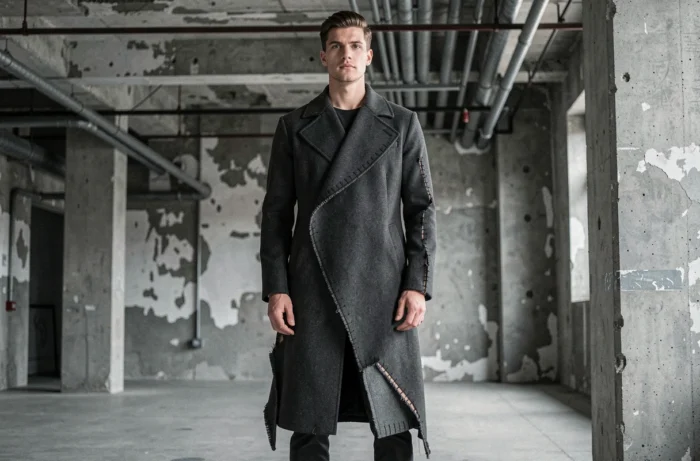
Carol Christian Poell has been making his pieces in Milan since 1994, outside of any seasonal calendar. His intentionally limited production relies on textile processes and materials that most houses do not work with, from transparent leather to metal integrated into the very structure of the garment.
Object dyeing and unconventional materials at Carol Christian Poell
The most documented technique of Poell remains the dyeing on finished objects. The garment or shoe is assembled and then dyed in a single immersion. This process reverses the standard industrial logic, where the material is dyed before cutting.
The result is an irregular coloration, dependent on the density of the seams, the layering of materials, and the local porosity of the leather or fabric. Two identical pieces in pattern are never identical in dye. Here we observe an explicit rejection of industrial reproducibility, not as a marketing stance, but as a direct consequence of the technical process.
Poell also uses atypical materials: leather made translucent by chemical thinning, structural metal inserts, closures borrowed from everyday objects (old keys, industrial rings). The assembly mixes classic tailoring logic with an almost sculptural construction, featuring visible seams that contribute to the design of the piece rather than hiding.
To learn everything about Carol Christian Poell, one must go beyond a purely aesthetic reading and consider the manufacturing constraints that define each piece.
Limited production and rejection of the seasonal system
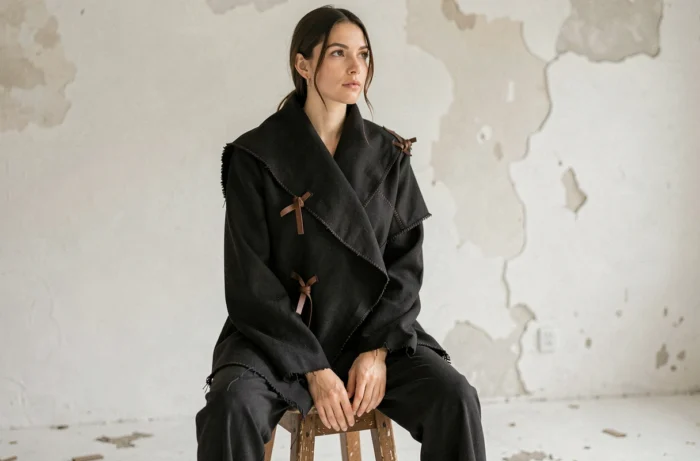
Poell does not present collections in the calendar sense of the term. Pieces arrive in waves, according to a rhythm dictated by the manufacturing process and not by fashion weeks. This operation has a direct consequence on distribution: points of sale are rare, and quantities per model are often counted in dozens of copies.
Each piece functions as a prototype with limited production. This is not a strategy of artificial scarcity. The complexity of the processes (dyeing on objects, long chemical treatments, manual assemblies) makes scaling up technically incompatible with the desired level of finish.
Historical retailers, such as L’Éclaireur in Paris or Alan Bilzerian in the United States, receive occasional deliveries without a guarantee of restock. This model generates an active secondary market, where pieces circulate at prices often higher than the initial rate.
Carol Christian Poell in rap culture and Asian street style
The emergence of Poell in cultural spheres far removed from European conceptual fashion is a recent phenomenon. Critics from the New York Times have noted that Carol Christian Poell now appears in rap lyrics, cited alongside much more publicized designers.
This shift is significant. A designer without an active Instagram account, without commercial collaborations, without a guest artistic director, finds himself referenced in a musical genre that values in-depth knowledge of brands as a status marker. The actual rarity of the product fuels its symbolic value in rap.
Presence in the street style wardrobe in Tokyo
A Fashionsnap report dated August 2026 credits Carol Christian Poell shoes in a street style look photographed in Tokyo, alongside Dries Van Noten. This type of credit marks a change: Poell is no longer confined to avant-garde European circles.
We observe a gradual normalization in the high-end Asian wardrobe, driven by buyers who integrate his pieces into mixed silhouettes, far from the “full CCP” outfit that specialized forums sometimes promote.
Deconstruction of tailoring: what Poell borrows and what he destroys
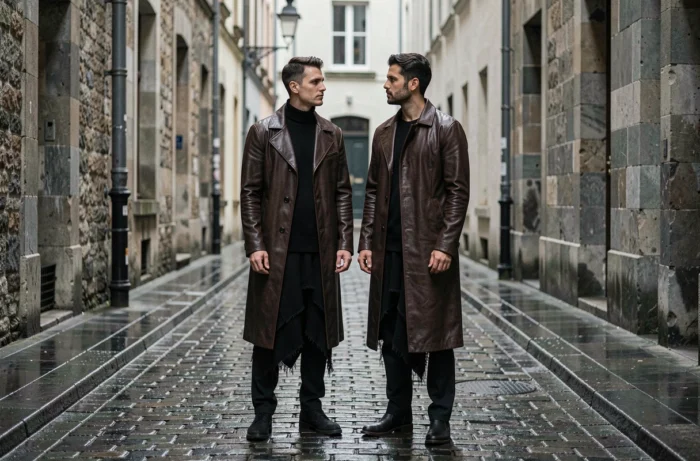
Poell’s work starts from a classic tailoring base. Blazers retain a recognizable shoulder construction, and trousers respect a conventional drape. Deconstruction then occurs, either by subtraction or by adding elements foreign to the tailoring vocabulary.
- Pockets are closed with heterogeneous closures (industrial zips, old key rings, definitive stitching making the pocket inaccessible)
- Assembly seams, normally hidden in the lining, are exposed on the outside and contribute to the graphic design of the piece
- Post-assembly treatments (dyeing, scarification, chemical treatment of leather) deliberately distort the initial proportions of the pattern
This method produces garments that maintain a readability of cut while sabotaging the expectations associated with that cut. A blazer remains identifiable as a blazer, but its finishes contradict the codes of the garment it appears to be.
Secondary market and authentication of Carol Christian Poell pieces
The rarity of production and the absence of restock create a resale market where authentication poses a real technical problem. Poell’s pieces do not carry a standardized serial number. Labels vary according to production periods.
Identification relies on knowledge of the processes: regularity of dyeing on objects, type of hardware used, quality of exposed seams. Experienced buyers examine the consistency between surface treatment and internal construction.
- Counterfeits rarely convincingly replicate the dyeing on objects, as the process generates variations that are impossible to simulate by printing
- The hardware (zips, rings, buckles) comes from specific industrial suppliers whose references change according to periods
- The exposed seams follow assembly logics specific to the Milan workshop, difficult to reproduce without the original templates
The Asian secondary market, particularly in South Korea, represents a growing share of transactions for these pieces, with local platforms developing their own verification protocols.
Carol Christian Poell remains an atypical case in contemporary fashion: a designer whose influence grows in inverse proportion to his visibility. Pieces circulate, are referenced in rap lyrics, are photographed in the streets of Tokyo, but the Milan workshop continues to operate at the same pace, indifferent to demand.


