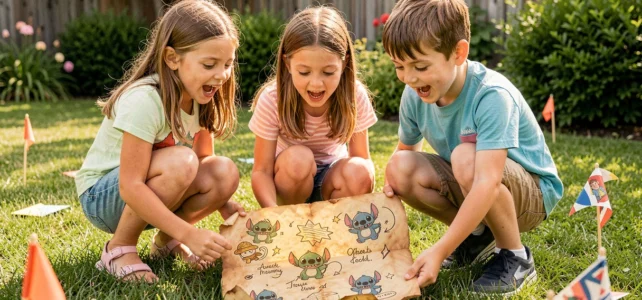
Your child is asking for a Stitch-themed birthday party, and you would like to offer more than just a simple piñata. A printable treasure hunt kit transforms your living room or garden into an adventure ground, without complex logistics. The principle: download a PDF file, print the materials at home, cut them out, hide the clues, and let the children solve the puzzles to find the treasure stolen by Stitch.
Adapting the Stitch course to your real space
Most printable kits assume you have a large garden. In practice, many parents organize the party in an apartment, a small living room, or a shared courtyard. This is a point that competing guides overlook, while it conditions the entire success of the game.
Before printing anything, scout room by room. Count the possible hiding spots: under cushions, inside a shoe closet, behind a frame, in the laundry basket. Five to eight hiding spots are enough for a smooth course with kindergarten or early primary school children. Beyond that, attention wanes.
For an outdoor space, prioritize hiding spots at child height. A clue taped under a garden table works. A clue stuck in a hedge one and a half meters off the ground works much less for four-year-olds. If you mix indoor and outdoor, plan a clear transition in the scenario (for example, Stitch escaping through the window and leaving a trace outside).
You can also use a printable Stitch treasure hunt designed to adapt to different types of locations, with placement instructions that can be adjusted according to your home’s layout.
Stitch puzzles by age group: what really works
You may have noticed that a four-year-old and an eight-year-old do not solve the same type of challenge at all? The classic trap is to choose a generic kit and end up with puzzles that are too easy for the older kids or incomprehensible for the younger ones.
For ages 3-5: visual clues
At this age, reading is not yet acquired. The puzzles that work rely on images to match, simple puzzles, or oral instructions read by an adult. A drawing of Stitch pointing to a recognizable object (a fridge, a tree) guides the child without frustration.
Short physical challenges capture attention better than riddles. Asking them to jump three times like Stitch before opening the next envelope, for example, re-energizes the group.
For ages 6-8: simple rebuses and codes
Children in this age group love decoding. A message written backward, a rebus mixing drawings and syllables, or a color code to decipher with a grid provided in the kit keeps them engaged. Alternating a logic puzzle with a small dexterity challenge maintains a good pace throughout the game.
For ages 9 and up
Older kids appreciate a real narrative. The story of Stitch stealing candy or sabotaging the party becomes a credible thread. The puzzles can include calculations, themed crosswords, or more elaborate coded messages.
Contents of a printable Stitch kit: what it should include
Not all kits are created equal. Before downloading or purchasing, check the list of provided items. A complete kit generally contains:
- A detailed instruction sheet for the organizing parent, with the order of hiding spots and the course of the scenario
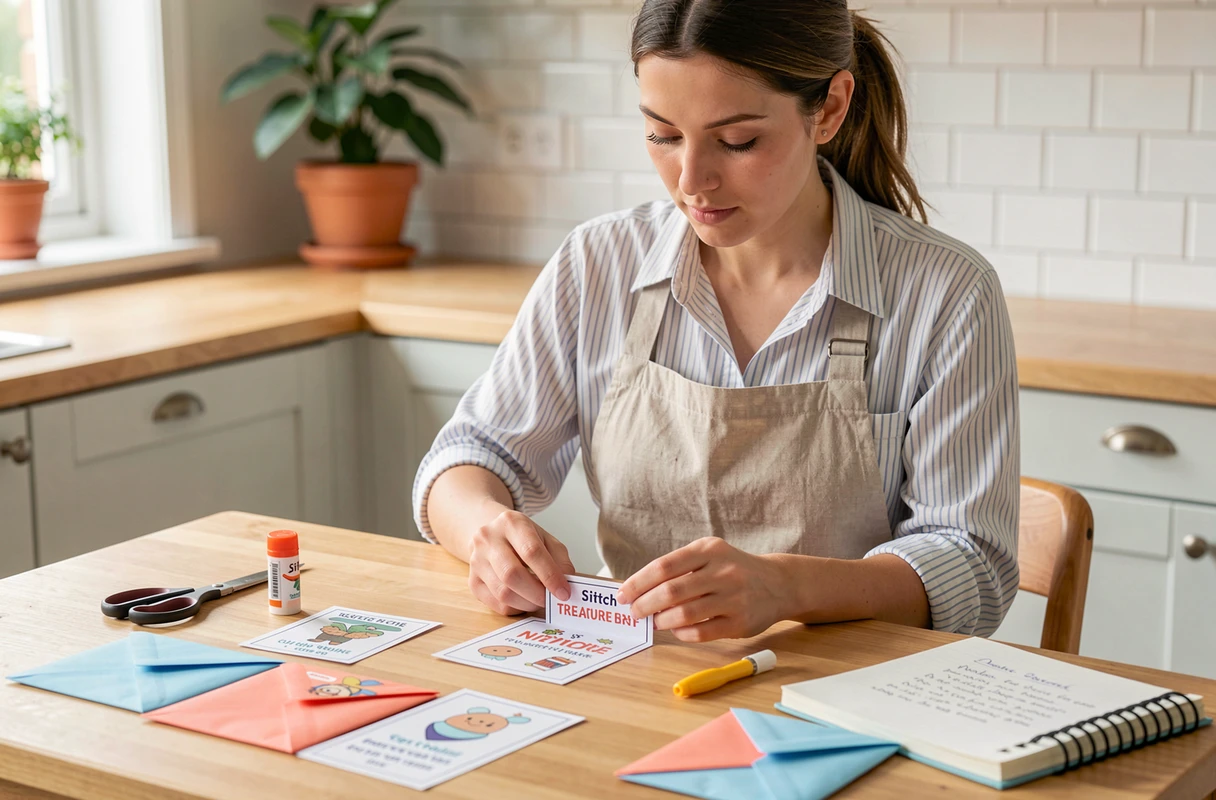
- The illustrated puzzles to cut out, ideally on paper with a sufficient weight to withstand children’s hands
- Optional decorative elements (banners, labels, invitations) that enhance immersion in the Lilo and Stitch universe
- A diploma or certificate of adventure completion, a small detail that makes a big impact at the time of treasure presentation
A good kit also includes variations based on location (indoor or outdoor) and specifies which puzzles to remove or add based on the number of children. Without this flexibility, you will spend time making last-minute adjustments.
Organization on the big day: supervision that makes a difference
The scenario is ready, the clues are hidden. The remaining question that many parents underestimate is: how many adults are needed to supervise the game?
For a group of four to six children under six, two adults represent the comfortable minimum. One adult reads the instructions and guides the group. The other supervises movements, especially if the course mixes indoor and outdoor or crosses an area with fragile objects.
With older children (seven years and up), one adult may suffice if the course is well marked. Still, plan a help system: an “bonus clue” envelope that the children can open if they have been stuck on a puzzle for several minutes. This mechanism avoids frustration without breaking the fun of the search.
Managing mixed ages during the birthday party
Siblings and groups of friends often mix children of different ages. A practical tip: create mixed pairs (an older child with a younger one). The older one reads the puzzle, and the younger one searches for the hiding spot. This duo system prevents the older kids from monopolizing the game.
If the age gap exceeds three years, consider two parallel courses with different hiding spots but a common treasure at the end. The kit should then be printed in duplicate, which remains simple with a PDF file.
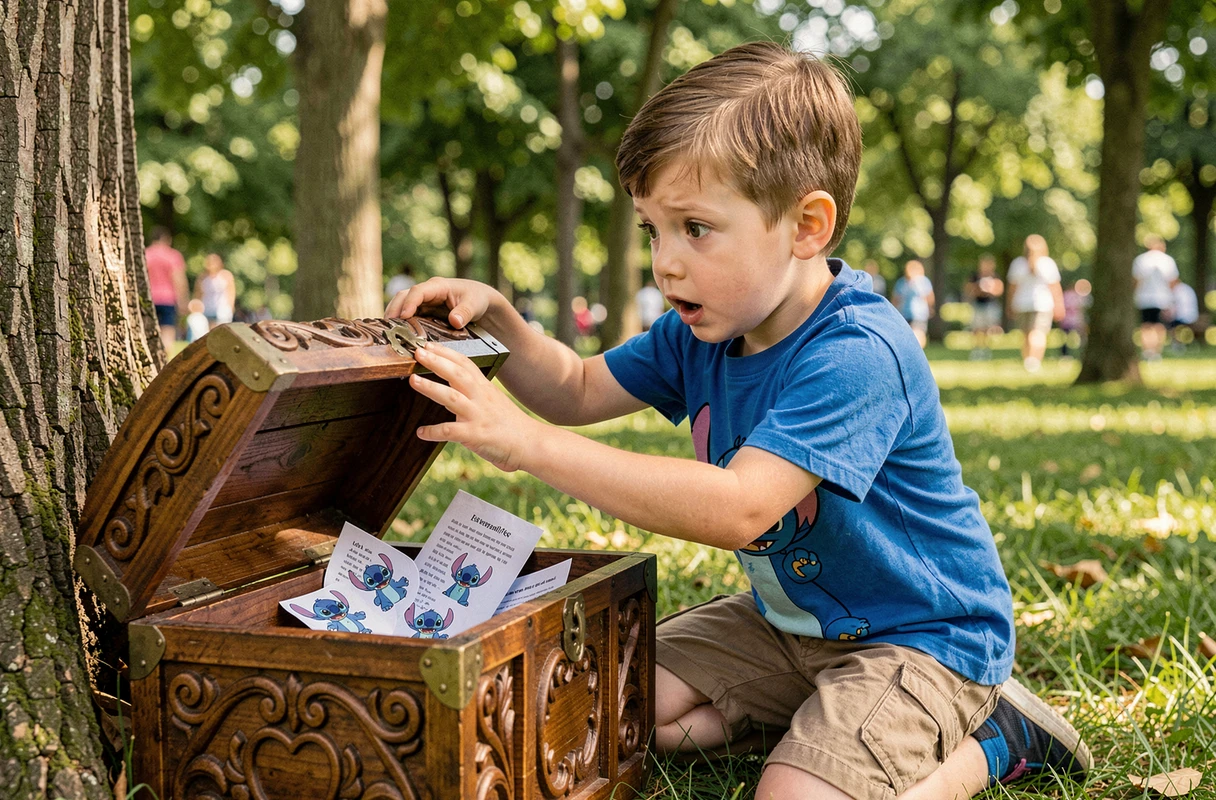
The final treasure: what to put in the box
The contents of the treasure matter as much as the course. After several puzzles solved, an empty box or a single candy causes disappointment. Plan a mix of small thematic items:
- Individual candy bags (one per child, not a single bag to share)
- Printable Stitch coloring pages to take home, easily found on sites like coloriage.info
- A small item related to the Stitch universe (stickers, mini figurine, bracelet) that serves as a party souvenir
Wrap the box in blue paper to recall Stitch’s color. This visual detail, combined with the adventure completion diploma, transforms a simple game into a memorable keepsake for the children.
The success of a Stitch treasure hunt relies less on the number of puzzles than on their adaptation to the present group. A well-chosen kit and a course tailored to your real space will do more than the most elaborate scenario printed without prior thought.