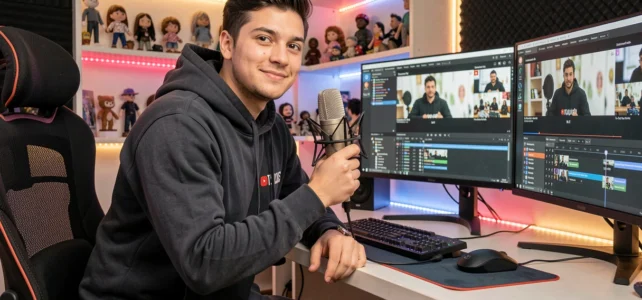
Sidjil Mahiddine Ben Gana, alias Djilsi, born on April 25, 1997, in Paris and raised in Toulouse, has over 2,350,000 subscribers on YouTube in 2026. Behind the recurring searches about his age and height lies a creator’s journey whose editorial mechanics deserve a more nuanced reading than just a simple biographical portrait.
Djilsi’s multimodal personal branding: anatomy of a chameleon positioning
Djilsi does not limit himself to one format. Hidden cameras with Cache la Cam, documentary series, survival content, boxing fights during the DTR Fight, cinema screenings with “On va où?”: each format serves a strategic repositioning. This is not dispersion; it is a multimodal personal branding built to capture segmented audiences across distinct verticals.
A viral sketch like “The Worst Student at University” targets the 16-24 age group looking for situational humor. A survival video or a cinema documentary reaches a broader audience, often male, interested in self-improvement. The common thread remains Djilsi’s personality itself, which acts as the umbrella brand for the whole.
If you are looking for Djilsi’s height, you will notice that this information remains one of the most searched even though it provides no insight into what truly makes his creative uniqueness.
We observe in Djilsi a rare ability to pivot formats without losing his community. His Bac L with an arts option and his BAFA training are not anecdotal: they reflect a cultural and educational foundation that structures his production choices.
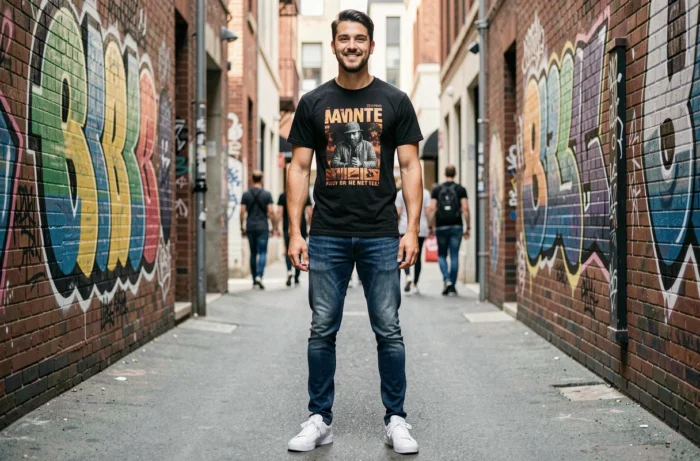
Djilsi and his physical transformation: what the creator says about his image
Competing articles mention Djilsi’s height and age as fixed data. None question the relationship he has with his own physical image or how he plays with this perception.
In a YouTube replay titled “MECCHA CHAMELEON,” Djilsi ironically claims to be 40 years old. This type of deliberate discrepancy between biographical reality and public persona is characteristic of his method. He blurs the lines, fuels curiosity, and transforms every factual question into a lever for engagement.
His physical transformation, visible between his early videos from 2018 and his recent appearances in the DTR Fight ring, has never been the subject of a classic “before/after.” Djilsi integrates this evolution into his overall narrative of self-improvement, without monetizing it as a fitness program. Boxing, field documentaries, physical challenges: the body becomes a narrative tool, not a product.
Djilsi’s age and creative trajectory: the timeline that matters
Born on April 25, 1997, Djilsi is 29 years old in 2026. His first video dates back to 2018, which means he launched his channel at 21. The rise has been rapid: the Cache la Cam series gained him 100,000 subscribers in just one week.
Here are the milestones that structure his journey:
- #DiscoverYourCountry and Journal de Bord in 2018 lay the groundwork for hybrid content between travel and personal storytelling, far from pure sketch format
- Cache la Cam triggers viral explosion with situational concepts (“The Worst Hotel Guest”) based on improvisation and acting
- The transition to DTR Fight marks a shift in genre: from pure entertainment to physical and competitive content that broadens the demographic target
- “On va où?”, screened in cinemas, breaks the barrier between web creator and traditional audiovisual producer
Each pivot corresponds to a measurable audience milestone. The diversification is not random: it follows a logic of escalation where each new format legitimizes the previous one.
The limits of Djilsi’s public persona
Djilsi’s public biography remains poorly documented in a reliable manner. Available articles recycle the same elements (age, Toulouse origin, YouTube journey) without questioning the deliberate gray areas.
Djilsi meticulously controls what filters from his private life. His separation from Sacha, mentioned on several sites, has never been commented on in detail by the main interested party. This management of the public/private boundary is as much an editorial choice as a personal one.
The term “chameleon” often comes up to describe him. We believe it is less about natural versatility and more about a deliberate strategy of renewal. A creator who sticks to one format eventually saturates their audience. Djilsi anticipates this saturation by changing genres before signs of fatigue appear in his metrics.
The downside of this approach is the risk of identity dilution. When a creator moves from sketch to boxing to cinema documentary, the question is no longer “who is Djilsi” but “which Djilsi are we watching”. For now, coherence holds thanks to the strength of his on-screen personality. The longevity of this model will depend on his ability to maintain a readable narrative thread across increasingly distant formats.
Djilsi as a YouTube creator: what sets him apart from the rest of the Francophone landscape
The Francophone YouTube scene is full of specialized creators: gaming, lifestyle, popularization. Djilsi refuses specialization, and it is precisely this refusal that constitutes his signature.
His academic background (Bac L in arts, BAFA) gives him a culture of staging and group facilitation that most self-taught creators lack. This is evident in the construction of his hidden cameras, where the scenario relies on precise theatrical mechanics, not on raw improvisation.
With over 2.3 million YouTube subscribers and 400,000 Twitch followers, Djilsi operates on two platforms with different algorithmic logics. YouTube rewards polished production and long format. Twitch values live interaction and regularity. Managing both requires a professional production team and organization.
Searches about Djilsi’s age, height, or origin will continue to fuel Google queries. What deserves more attention is the diversification mechanism that allows him to remain relevant after several years on a platform where the average lifespan of a viral format is measured in months.