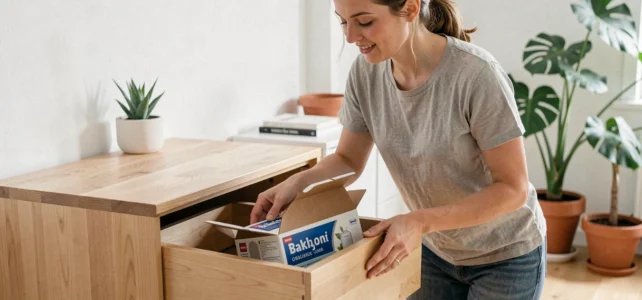
We unpack an Ikea piece of furniture in the bedroom, close the door, and the next morning the acrid smell hits the throat as soon as we enter. This is not a manufacturing defect: the particle boards and MDF used in most ranges (PAX, KALLAX, MALM) release volatile organic compounds, especially formaldehyde, from the resins that bind the wood fibers.
The peak emission occurs in the first hours after unpacking, then gradually decreases, provided the furniture is not left to marinate in a closed room.
Formaldehyde and particle boards: what an Ikea piece of furniture really releases
The chemical smell of new furniture mainly comes from the formaldehyde trapped in urea-formaldehyde based glues. Particle boards, MDF, and plywood are the most affected. A solid wood piece of furniture, on the other hand, does not emit this type of chemical residue: its smell (often of pine or birch) is considered natural and does not involve the same mechanism.
Since August 6, 2026, the European regulation (EU) 2023/1464 caps formaldehyde emissions from items intended for indoor use at 0.080 mg/m³. This threshold, stricter than the previous E1 standard, applies to furniture as well as curtains, carpets, and other indoor products. Ikea furniture sold in Europe must therefore comply with this limit, which reduces the problem at the source without completely eliminating it.
To properly understand how to remove the smell from a new Ikea piece of furniture, we must first accept that ventilation alone is not enough: it is necessary to combine ventilation, absorption, and, in some cases, surface cleaning.
Airing an Ikea piece of furniture: method and realistic duration
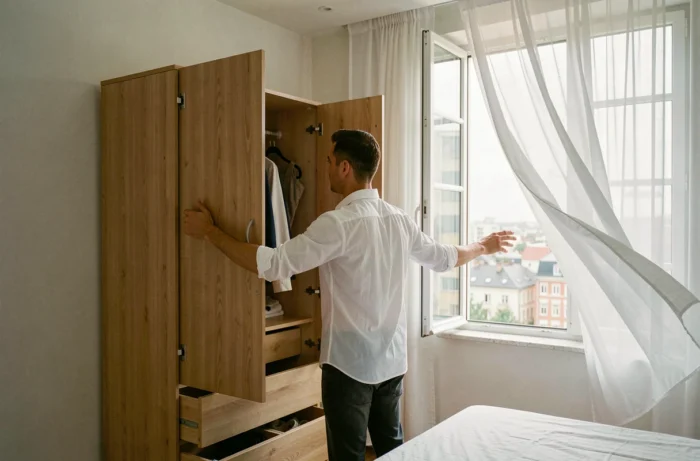
The first thing to do after assembly is to open all the doors, drawers, and compartments of the furniture. VOCs accumulate in closed volumes. A drawer left closed for three days concentrates much more formaldehyde than an open drawer in a ventilated room.
Cross ventilation and temporary placement
Ideally, place the furniture in the best-ventilated room of the house, with the window open facing a door, to create a cross breeze. If you have a balcony, a covered terrace, or a ventilated garage, installing the furniture there for the first few days significantly speeds up the process.
Heat promotes off-gassing. In summer, emissions are faster (which explains why the smell seems stronger), but the total off-gassing duration shortens. In winter, in a heated and poorly ventilated apartment, experiences vary on this point, but it is often observed that the smell lingers longer.
- Open each drawer, door, and removable shelf as soon as assembly is complete
- Maintain ventilation for at least the first three days, ideally continuously
- Avoid storing linens or clothes in the furniture as long as the smell remains noticeable, to prevent textiles from absorbing it
- Do not block air circulation by placing the furniture against a wall without backspace
Absorbing odors from new furniture with common products
Airing expels VOCs into the ambient air. Absorption, on the other hand, traps odor molecules on the surface of a porous material. The two approaches complement each other.
Baking soda on interior surfaces
Sprinkle a thin layer of baking soda on the shelves and the bottom of the drawers. Leave it overnight, then vacuum. Baking soda neutralizes the volatile organic acids responsible for part of the smell. For a PAX or BRIMNES, it may be necessary to repeat this two or three times.
Activated charcoal and coffee grounds
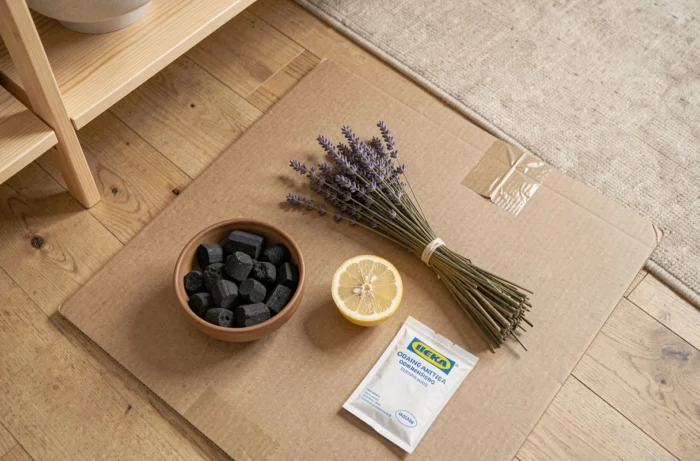
Activated charcoal (in bags or loose in a bowl) is the best absorber for household formaldehyde. Place an open container in each closed compartment of the furniture. Dried coffee grounds also work, but their effectiveness is lower and they leave their own smell, which is more suitable in a kitchen than in a bedroom.
Cleaning the interior walls to accelerate off-gassing
Ikea recommends on its support page to wash the interior surfaces of the furniture with warm water mixed with a little white vinegar. This cleaning removes the superficial layer of chemical residue and reduces the amount of formaldehyde that continues to be released.
Use a wrung microfiber cloth, not a sponge soaked in water. Excess moisture causes particle boards to swell and can degrade the structure of the furniture. Wipe immediately with a dry cloth, then leave doors and drawers open for drying.
White vinegar or soapy water: how to choose
White vinegar (diluted in equal parts with water) has the advantage of partially neutralizing the alkaline residues from the glues. Classic soapy water (Marseille soap, a few shavings in warm water) is suitable if you want to avoid the smell of vinegar, which disappears as it dries but can be bothersome for sensitive individuals.
- Diluted white vinegar: effective on glue residues, dries without leaving a film
- Marseille soap shavings: gentler, suitable for fragile melamine surfaces
- Diluted household alcohol: degreases varnished surfaces but should be tested first in a hidden corner
Common mistakes that prolong the smell of an Ikea piece of furniture
Some reflexes worsen the problem instead of solving it. Indoor air fresheners and scented candles mask the smell without eliminating VOCs. Worse, some diffusers add their own chemical compounds to the indoor air.
Wrapping the furniture in plastic wrap “to contain the smell” is counterproductive: it blocks off-gassing and pushes the problem away. Formaldehyde will continue to be released as soon as the wrap is removed.
Another common mistake: assembling the furniture directly in a child’s room or a room without a window. If possible, assemble the furniture in the living room or a well-ventilated room, let it off-gas for a few days, then move it to its final location.
With the new European formaldehyde threshold in effect since August 2026, emissions from new furniture sold in Europe are mechanically lower than before. The smell remains noticeable upon opening, but a combination of ventilation, wet cleaning, and natural absorbents allows for its removal in just a few days in the vast majority of cases.