
You buy a used car on a Saturday afternoon, shake hands with the seller, and the countdown begins. The one-month deadline for changing the registration holder starts from the date on the transfer certificate, not from the handover of the keys. Missing this window can result in a fine of up to 750 euros and the immobilization of the vehicle.
Date of the transfer certificate: the one-month deadline trap
In practice, many buyers confuse the effective handover date of the vehicle with the date on the Cerfa transfer form. It is the latter that is authoritative for calculating the legal deadline.
When the seller fills out the transfer certificate with a date prior to the actual transaction (for insurance or technical inspection reasons), the buyer unknowingly loses days. It is recommended to systematically check the consistency between the date on the Cerfa and the day of the sale before signing.
Another often overlooked point: the seller must declare the transfer on the ANTS website within fifteen days. Without this declaration, the buyer’s registration request may be blocked. If the seller delays, it’s important to follow up quickly, as no online recourse allows bypassing this step.
To better understand the procedure for changing the registration holder, it’s helpful to gather all documents before even going to pick up the vehicle.
Cost of changing the registration: the five taxes that make up the bill

The total price of the registration certificate is not a single amount. It is broken down into five distinct lines, and it is the regional tax that varies the bill from simple to triple depending on the place of residence.
- Regional tax (Y.1): calculated by multiplying the vehicle’s fiscal power by the tax rate set by each region. This is the most variable item.
- Tax on polluting vehicles (Y.3): applies to models with high CO2 emissions, absent for clean vehicles.
- Management fee (Y.4): a fixed amount identical across the territory.
- Delivery fee (Y.5): covers the sending of the certificate by tracked mail to the home address.
- Fixed tax (Y.6): a base fee applied to all registration requests.
The minimum unavoidable amount, for a vehicle exempt from regional tax, is 13.76 euros (fixed tax plus delivery fee). For a vehicle of average power in a region with a high rate, the bill increases significantly.
Electric vehicles: the end of automatic exemption
Since May 1, 2025, the exemption from regional tax for electric vehicles is no longer systematic. In 2026, almost all regions will apply the full rate to electric cars.
The Hauts-de-France region is an exception with a partial exemption still in effect. For all other territories, you now pay the same regional tax as a thermal vehicle of equivalent power. The savings that made used electric vehicles attractive in terms of registration costs have largely disappeared.
Documents required for online registration holder change
The process is done exclusively online, either on the ANTS platform or through an authorized professional. You can no longer go to the prefecture for this formal procedure. Here are the documents to gather before starting the request:
- The transfer certificate (Cerfa 15776) signed by both parties.
- The old registration certificate crossed out with the mention “sold on” followed by the date and time, signed by the seller.
- A proof of residence dated within the last six months.
- A valid identification document.
- A technical inspection less than six months old for vehicles over four years old (except in special cases such as classic vehicles or low-displacement two-wheelers).
- The transfer code provided by the seller after their declaration on the ANTS.
The absence of even one document blocks the request. The most common reason for rejection remains an expired technical inspection by a few days or a transfer certificate whose date does not match the seller’s declaration.
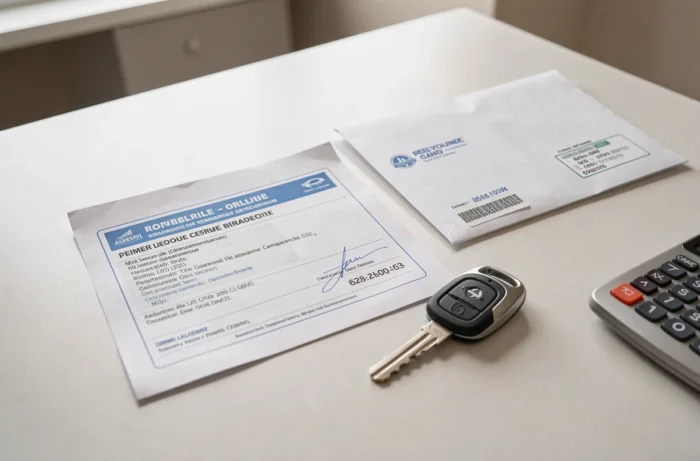
Provisional registration certificate: driving while waiting for the registration
Once the request is validated on the ANTS, you immediately receive a provisional registration certificate (CPI). This document allows you to drive legally for one month while waiting for the receipt of the final title.
The registration certificate then arrives by tracked mail at your home, usually within a few working days. Returns vary on this point: some buyers receive the document in three days, while others wait two weeks during peak periods.
The CPI carries the new registration number of the vehicle. Therefore, you can take out insurance and drive normally as soon as you receive it. In the event of a roadside check, it serves as the registration certificate for its entire validity period.
Technical inspection and transfer: a variable requirement depending on the case
The technical inspection is not always required when changing ownership. It applies to standard sales of vehicles over four years old, but a donation or inheritance follows different rules.
In the case of a vehicle donation between family members, the transfer as a gift sometimes exempts from the technical inspection if the vehicle remains within the household. For a divorce, the situation depends on the allocation of the vehicle in the context of property division: the change of holder remains mandatory, but the required documents may differ.
In all cases, the presented technical inspection must be favorable or include a re-inspection completed before the transfer. An unfavorable report that has not been rectified renders the registration request inadmissible.
The key point to remember: verifying the exact validity of the technical inspection before signing the transfer certificate helps avoid ending up with a vehicle that cannot be registered until the seller has taken the necessary steps, and a one-month deadline that continues to run.