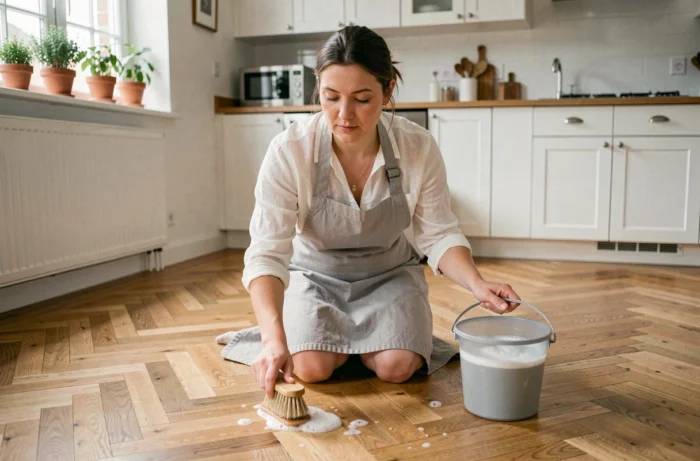
Cleaning a house is not just about scrubbing surfaces. It is an operation that involves chemical reactions, product choices, and time management, the effectiveness of which depends on a few counterintuitive principles. Understanding these mechanisms changes the quality of the result as much as the effort expended.
Indoor air pollution related to scented household products
A rarely addressed angle in cleaning guides concerns air quality during and after cleaning. Research conducted by Professor Brandon Boor at Purdue University shows that the fragrances in household products react with indoor ozone and generate ultrafine nanoparticles. These particles, ranging in size from 1 to 30 nanometers, penetrate deeply into the respiratory system.
The level of pollution produced is comparable to that of exposure to traffic on a busy street. Products containing significant oils are no exception: their chemical composition triggers the same reactions with ambient ozone.
This finding also applies to devices generating ozone, such as certain UV-C germicidal lamps. When used alongside scented cleaners, they amplify the production of nanoparticles. For more in-depth information on cleaning best practices and their implications, a useful resource is: https://www.leguidedunettoyage.fr/.
Protective gestures are simple but often overlooked:
- Prefer products without added fragrance, including those labeled “natural,” which still contain reactive volatile organic compounds
- Open windows during cleaning and maintain ventilation for at least thirty minutes afterward to clear suspended particles
- Limit the use of aerosols, which disperse odor molecules over a contact surface much larger than a liquid product applied with a cloth
Effective cleaning with baking soda and white vinegar: what really works
Baking soda and white vinegar are mentioned everywhere. Their actual effectiveness depends on how they are used, and especially on the order in which they are applied.
Baking soda: a mild abrasive and odor neutralizer
Baking soda works through two distinct mechanisms. As a slightly abrasive powder, it removes ingrained residues on cooktops, sinks, or oven walls without scratching surfaces. As a weak base, it neutralizes acids responsible for certain unpleasant odors, particularly in refrigerators or drains.
Its effectiveness on cooked grease increases when mixed with hot water to form a thick paste, applied directly to the soiled area and left in contact for about twenty minutes.
White vinegar: a descaler, not a degreaser
White vinegar excels at removing limescale. It is a diluted acetic acid that dissolves mineral deposits on faucets, in kettles, and inside dishwashers. For effective descaling, a 14-degree vinegar yields better results than regular cooking vinegar.
Mixing baking soda and vinegar in the same container cancels their respective properties. The acid-base reaction produces carbon dioxide (the visible bubbles), water, and sodium acetate, a neutral salt with no particular cleaning power. Using the two products separately, one after the other, on different types of stains yields a significantly better result.
Zone cleaning method for regular maintenance
Most guides recommend a weekly plan room by room. This approach has a limitation: it treats each room as a homogeneous unit, while stains are distributed by type, not by room.
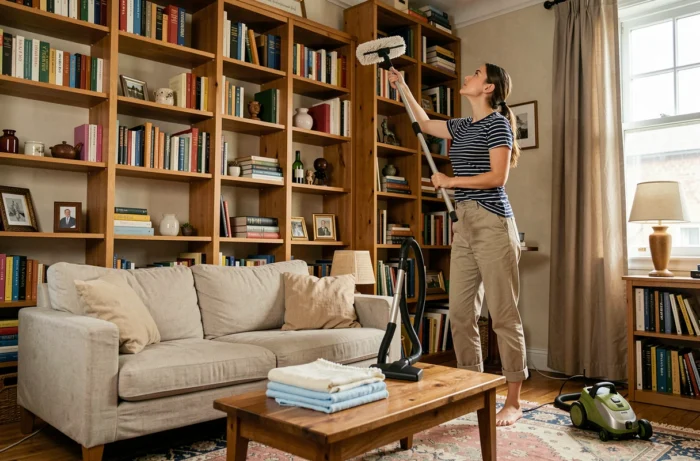
Grouping tasks by surface type reduces product and equipment changes. All glass surfaces (mirrors, windows, screens) are cleaned in the same sequence. All textile surfaces (sofa, carpets, curtains) in another. This logic also prevents contaminating a clean surface with an unsuitable product.
The vertical order also matters. Starting with high points (shelves, tops of cabinets) ensures that dislodged dust falls onto surfaces that have not yet been cleaned. Ending with the floors avoids having to vacuum again after dusting a piece of furniture.
Frequency adapted to actual usage level
Not all areas of a house get dirty at the same rate. Door handles, light switches, and kitchen countertops accumulate residues daily. Baseboards, tops of frames, or ventilation grilles only require monthly attention.
Adapting the frequency to the actual usage rate of each surface prevents both excessive cleaning (which wears out materials and wastes product) and the accumulation of stubborn dirt that then requires disproportionate efforts to remove.
Sponge and microfiber cloth: choosing the right tool for the task
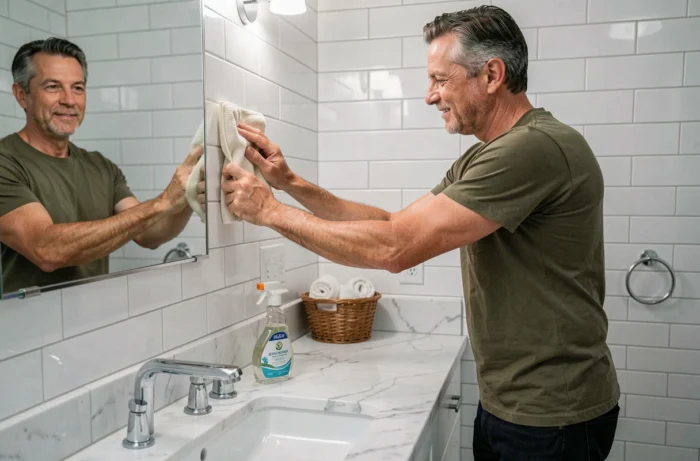
The choice of cleaning tool influences the result as much as the product. Microfiber cloths capture particles through electrostatic effect, allowing for dry dusting without chemical products. On smooth surfaces (glass, stainless steel, wall tiles), they leave fewer marks than a conventional sponge.
Abrasive-faced sponges remain useful for stuck residues, but their porous structure retains moisture and promotes bacterial growth within hours. Replacing a sponge every two weeks and allowing it to dry flat after each use limits this issue.
A final point rarely mentioned: microfiber cloths lose their effectiveness when washed with fabric softener. The softener leaves a greasy layer on the fibers that blocks their absorption and particle grip capacity. A machine wash at 60 degrees, without softener, is sufficient to regenerate them.
Cleaning a house becomes more effective once one understands why an action works, not just how to replicate it. Choosing a fragrance-free product, using the right abrasive on the right surface, and following a logical order of operations: these subtle adjustments transform a repetitive chore into a mastered routine, quicker and healthier for the air we breathe.


