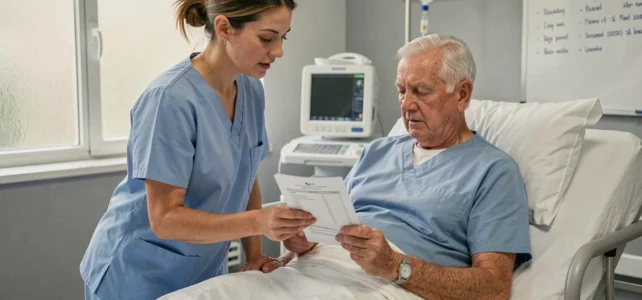
The order of June 26, 2026, published in the Official Journal on June 27, 2026, redesigns the scope of practice for nursing assistants. The text does not merely add a few actions to an existing list: it formalizes a list of acts delegable by the nurse, inserted directly into the regulatory framework of nursing acts. For professionals in the field as well as for students in IFAS, reading this text requires a shift in analytical perspective.
Delegable Acts for Nursing Assistants: A Framework for Delegation, Not a Catalog
The main break introduced by the June 2026 order lies in its very logic. Previous texts left room for interpretation regarding what the nursing assistant could or could not perform on a daily basis. The new text clarifies this by establishing a subsection dedicated to nursing assistants within the regulatory framework of nursing acts.
In practical terms, there is no autonomous “nursing assistant decree” for 2026. The operational reference is found in the order on nursing acts, with an explicit delineation of what can be entrusted by the nurse. This architecture has a direct consequence: each nursing assistant act is part of a shared responsibility with the nurse.
This distinction changes the professional stance. The nursing assistant no longer receives a generic “authorization to act,” but a scope articulated to the prescription and nursing supervision. Facilities that operated based on field habits will need to formalize their delegation protocols.
To understand in detail the practical implications of this evolution, the new nursing assistant reference framework 2026 provides a useful lens that distinguishes what falls under the legal framework and what pertains to internal organization.
Clinical Monitoring and Reasoning in Complex Situations: The Real Skill Advancement
The content published since the summer of 2026 converges on one point: the new scopes are not merely an extension of technical gestures. Structured clinical monitoring becomes a central axis of the profession.
The nursing assistant is now more frequently called upon for data collection, observation of clinical status, and situation analysis. In practice, this means that the transmission of information to the nurse is no longer limited to a descriptive observation (“the patient is in pain”), but must include more precise evaluation elements (location, intensity, evolution over time).
This shift towards analysis has repercussions on three levels:
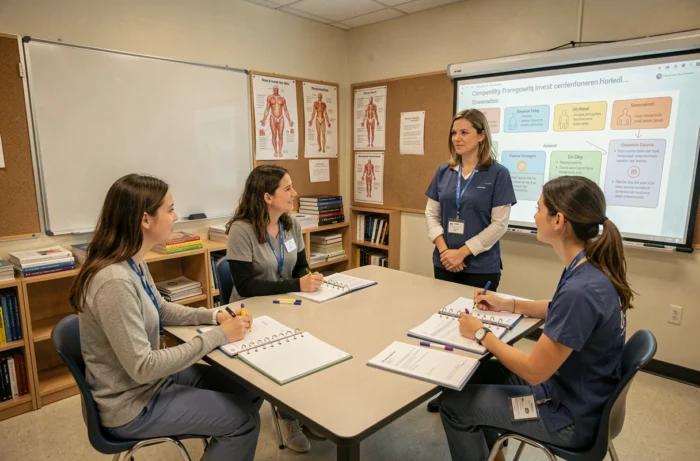
- Initial training includes clinical reasoning modules that go beyond simple gesture learning, with complex situational exercises starting in the first year
- Nursing assistants who graduated before 2021 must undergo an update training to integrate these skills, in accordance with the order of February 26, 2025
- Evaluations in work situations carry more weight compared to traditional written tests, which alters the validation criteria
The expected clinical reasoning remains distinct from that of the nurse. The nursing assistant identifies and transmits, the nurse analyzes and decides. The boundary between the two roles is clearer in the text than it was in previous practices.
Update Training for Nursing Assistant Skills: Who is Affected and Within What Timeline
The obligation for update training targets nursing assistants holding a diploma issued before the 2021 reengineering. The framework set by the order of February 26, 2025, provides for a structured program, generally delivered over three days, covering the new authorized acts and principles of clinical monitoring.
Field feedback varies on this point: some facilities have already scheduled training sessions for all their teams, while others struggle to find time in already strained services. The obligation exists, but the timeline for compliance remains unclear for a significant portion of the structures.
The training content covers several axes:
- Execution of new authorized care in acute situations, with evaluation and adjustment
- Research and analysis of clinical information allowing activities to be adapted according to age and care environment
- Identification of the limits of one’s scope of competence and articulation with the nursing role
For students currently in IFAS, this content is part of the initial curriculum. The gap thus lies between professionals trained after 2021, who are already up to date, and those trained under the old framework, for whom the upgrade is not optional.
Prevention and Coordination: What the 2026 Reference Framework Expects Beyond Care
The reference framework no longer confines the nursing assistant to direct care gestures. Prevention, long considered a secondary objective, is explicitly integrated into the core competencies. This includes the prevention of risks related to immobilization, malnutrition, or falls, with an expectation of traceability in transmissions.
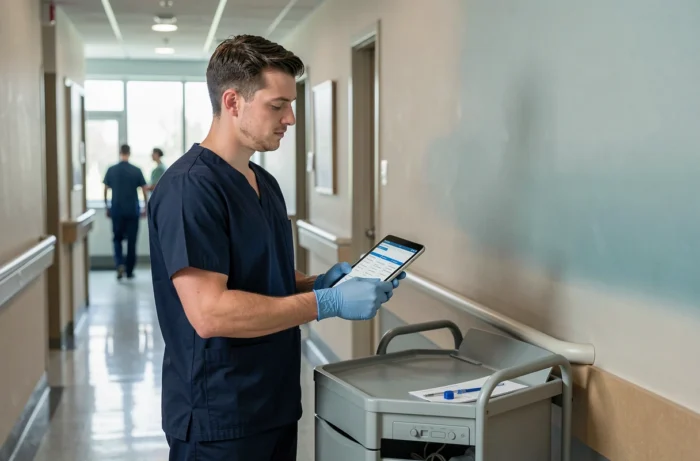
Coordination with the multidisciplinary team is the other strengthened axis. The nursing assistant participates in the continuity of the care pathway, not just in the execution of isolated tasks. Digital tools for transmission and clinical monitoring become expected competencies, including for professionals working in home care.
This evolution raises a question that the text does not fully resolve: will salary and statutory recognition follow the skill advancement? The available data does not allow for a conclusion on this subject, as negotiations remain ongoing in several sectors.
The 2026 reference framework marks a change in nature, not just in degree, in the nursing assistant profession. The ability of facilities to support this transition, in terms of training time and internal organization, will determine the gap between the official text and the reality of practices in the coming months.