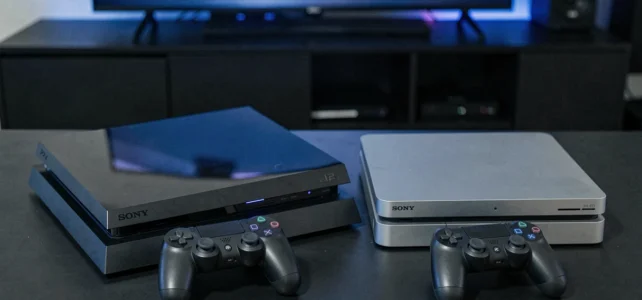
The classic PS4 (often referred to as PS4 Fat) and the PS4 Slim share the same eight-core AMD Jaguar processor and the same AMD Radeon GPU. Their game catalog is strictly identical. What separates them relates to the chassis, thermal management, and a few connectivity choices that Sony made between the release of the original model and that of the Slim version.
Thermal Management and Noise: What Really Changes Day-to-Day
The PS4 Fat features a cooling system designed in 2013. After a few years of use, dust accumulation on the heatsink and fan causes what forums describe as a “jet engine noise.” French repair workshop sheets confirm that the Fat is more sensitive to thermal clogging than the Slim.
Sony rethought the ventilation on the Slim. The fan is smaller, the chassis is better ventilated, and the reduced power consumption generates less heat to dissipate. In practice, the Slim remains significantly quieter, even after several years without internal cleaning.
With proper maintenance (periodic internal dusting, sufficient ventilation around the console), both models can operate stably for over ten years. The most common failures affect mechanical components (hard drive, optical drive), not the motherboard or GPU. A second-hand buyer can therefore aim for either without fearing premature obsolescence of the hardware.
To clearly understand the differences between classic PS4 and Slim from a technical standpoint, ventilation and noise are the most noticeable criteria on a daily basis.
Dimensions, Weight, and Connectivity of the PS4 Fat vs. PS4 Slim
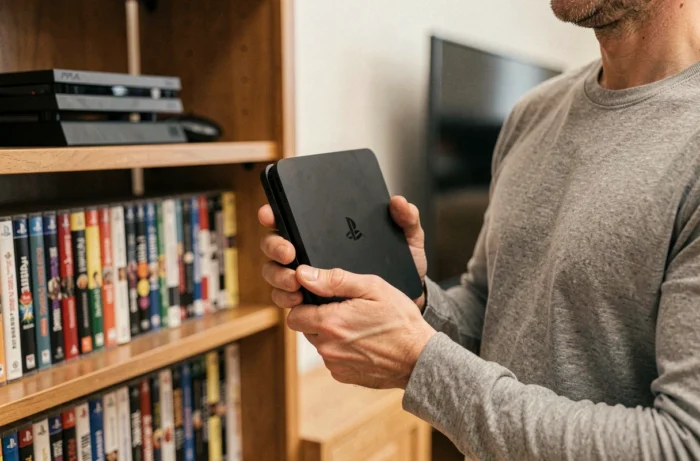
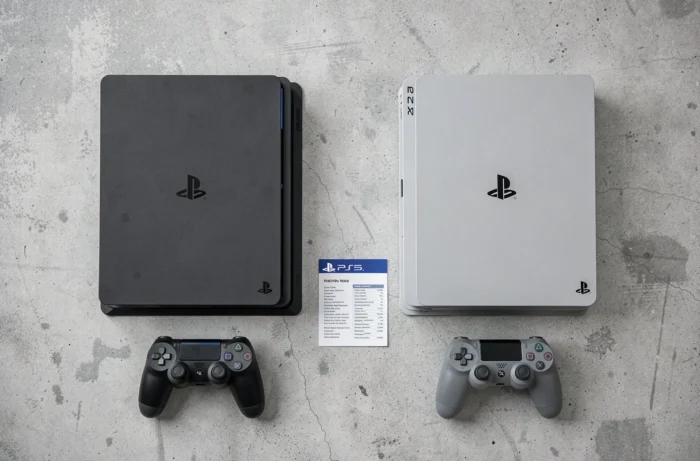
The size is the most visible difference. The PS4 Fat adopts an angular design and a bulkier silhouette. The Slim significantly reduces bulk and weight, making it easier to integrate into a TV stand or transport.
What the Slim Gains
- A thinner and lighter chassis, designed for tight spaces.
- A more compact integrated power supply, with significantly lower power consumption compared to the original model.
- Wi-Fi 5 (802.11ac), absent from the Fat which is limited to Wi-Fi 4. For online gaming or streaming, the difference in speed is tangible.
What the Slim Loses
The PS4 Fat has an optical audio output (TOSLINK). Sony removed it on the Slim. Users who connect an external DAC or soundbar via this output must go through HDMI or an audio extractor, which adds an adapter to the setup.
The Fat also offers a dedicated auxiliary port for the PlayStation Camera, replaced on the Slim by a different connection. For players using the first-generation PlayStation VR, both models remain compatible, but the wiring differs.
PS4 Slim in 2026: An End-of-Industrial-Cycle Console
Sony has officially stopped production of the PS4. The PS4 Slim is no longer an active product but a previous-generation console at the end of its industrial life. The installed base remains massive, and the second-hand market still largely feeds the supply.
This situation has several practical consequences for a buyer:
- Second-hand prices for the Slim and Fat continue to drop, but the Slim maintains a slightly higher value due to its quiet operation and compactness.
- The PS4 game catalog remains accessible via the PlayStation Store. Third-party studios continue to release some compatible titles, even if major releases now target the PS5.
- Spare parts (fan, power supply unit, Blu-ray drive) are still available, but their supply may decrease in the coming years.
The choice between Fat and Slim in the second-hand market therefore depends less on raw power (identical) than on physical and practical criteria.
Which PS4 Model to Choose Based on Usage
For standard living room use (gaming, video streaming, Blu-ray), the Slim offers the best compromise of noise, bulk, and Wi-Fi connectivity. Its newer chassis and reduced power consumption make it the logical choice for a console intended to be on for several hours.
The Fat remains interesting in two specific cases. The first: a very tight budget, as it often sells for less than the Slim in the second-hand market. The second: an audio setup that relies on the optical TOSLINK output, which is only present on the original model.
In terms of gaming performance, there is no difference. The same title runs at the same settings, at the same frames per second, on both machines. The DualShock 4 controller is compatible with both models without distinction, and saves transfer via PlayStation Plus cloud or USB drive.
A often overlooked point: check the condition of the hard drive before any second-hand purchase. It is the component that ages the fastest, and replacing it with a standard SSD significantly improves loading times on both versions of the console.