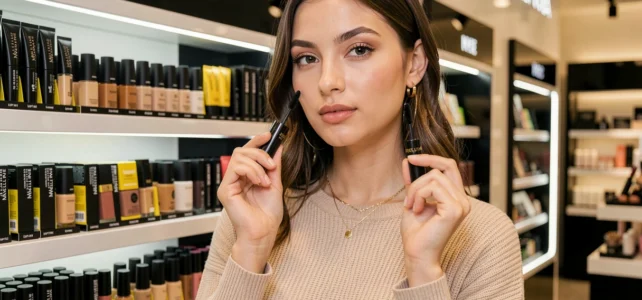
When a mass-market brand finds itself on the shelves of a distributor associated with prestige, the question is not so much why, but rather to measure what this rapprochement changes in the market. Maybelline at Sephora illustrates a broader movement: the merging of price segments that have long been separate, in a context where consumer demand is shifting from pure makeup to hybrid products that combine skincare and color.
Skinification of makeup: the constraint that redefines Maybelline’s positioning
Recent market studies confirm a decline in traditional makeup, with marked decreases in classic lipsticks and foundations. Skincare, clean formulations, and wellness supplements are progressing in their place. This shift forces any brand historically focused on accessible makeup to rethink its ranges to survive in a prestige environment.
Maybelline is no exception to this rule. Its presence at Sephora is not merely a transfer of existing products to a new point of sale. It implies an adaptation towards hybrid makeup and skincare formulas, which the industry refers to as the skinification of makeup.
For Maybelline’s presence at Sephora, the challenge is to offer textures enriched with moisturizing or anti-aging active ingredients while maintaining an accessible price. This positioning creates a productive tension: the consumer gains access to more technical formulas without crossing the price threshold of exclusively prestige brands.
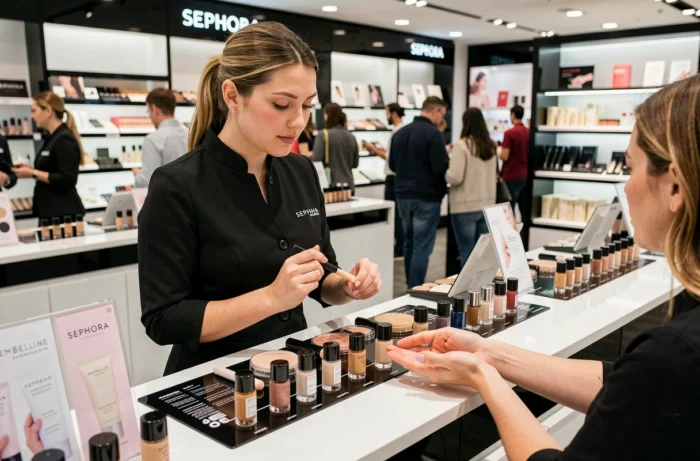
Beauty market in France: comparison of dynamics between makeup and skincare
The French context sheds light on the logic behind this alliance. Available data on the beauty market shows divergent trajectories between product categories.
| Category | Recent Trend | Impact on Prestige Distribution |
|---|---|---|
| Classic Makeup (foundation, lipstick) | Decline after several years of growth | Brands must differentiate through formula innovation |
| Hybrid Products (makeup + skincare) | Strong growth | Preferred niche for mass brands in a prestige environment |
| Clean Skincare | Sustained growth | Attracts a more discerning clientele regarding composition |
| Wellness Supplements | Rapid progression | Expands the scope of beauty retailers |
This table reveals a key point: accessible makeup can no longer settle for a good quality-price ratio. Demand is shifting towards transparency of composition and proven effectiveness, two criteria on which a retailer like Sephora imposes high standards on its suppliers.
High-low beauty strategy: why Sephora incorporates accessible brands
The high-low beauty phenomenon, well documented in the American market for several years, is gaining traction in France. The principle is simple: consumers combine luxury products and mass-market references in the same basket, without considering this mix as a compromise.
For Sephora, incorporating Maybelline serves several simultaneous objectives:
- Attracting a younger clientele who discovers the brand via social media and then seeks to purchase it in a carefully curated experience
- Offering entry prices that increase store visit frequency, including for complementary purchases of premium brands
- Responding to the trend of the “mixed basket” where an affordable mascara sits alongside a high-end serum, without the consumer feeling any dissonance
Contrary to a logic of cannibalization, accessible brands in a prestige environment increase the overall average basket. The consumer who comes for a Maybelline product often leaves with an item from a higher range, discovered through the store layout and advice.
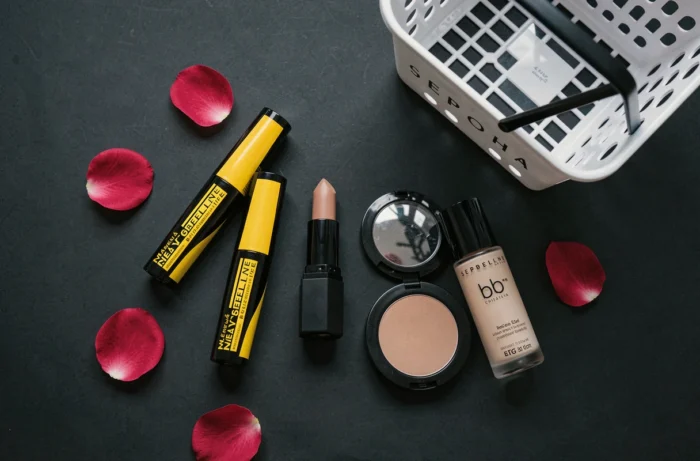
Hybrid cosmetics and consumer reviews: how selective distribution changes perceptions
A Maybelline product sold in a supermarket and the same product presented at Sephora do not generate the same perception. The sales environment alters the perceived value, and especially access to information.
At Sephora, each reference benefits from verified consumer reviews, detailed product sheets, and sometimes personalized beauty diagnostics. For a brand like Maybelline, this layer of information transforms an impulsive purchase into a well-informed purchase, which reduces the rate of disappointment.
The difference is also measurable in terms of formulation. The ranges offered in selective distribution tend to favor the most innovative references in the catalog: lightweight textures with a second-skin effect, mascaras enriched with care fibers, foundation bases with integrated sun protection. The basics remain in mass distribution.
- Hybrid makeup and skincare products represent the majority of Maybelline references highlighted at Sephora
- Transparency on ingredient lists meets the expectations of a clientele accustomed to clean beauty standards
- Exclusive formats or limited editions create a sense of rarity that enhances the brand’s attractiveness
A quality filter imposed by the distributor
Sephora does not distribute the entire Maybelline catalog. This selection acts as a perceived quality filter: only references aligned with the retailer’s composition and innovation requirements are retained. For the consumer, this curation simplifies choice and strengthens trust.
The French beauty market is undergoing a restructuring where the boundaries between mass and prestige lose their relevance. The presence of a brand like Maybelline at Sephora is not an accident, but a reflection of a demand that values product effectiveness over pricing. Retailers that can balance accessibility and formulation demands will capture the most dynamic market share in the coming years.